

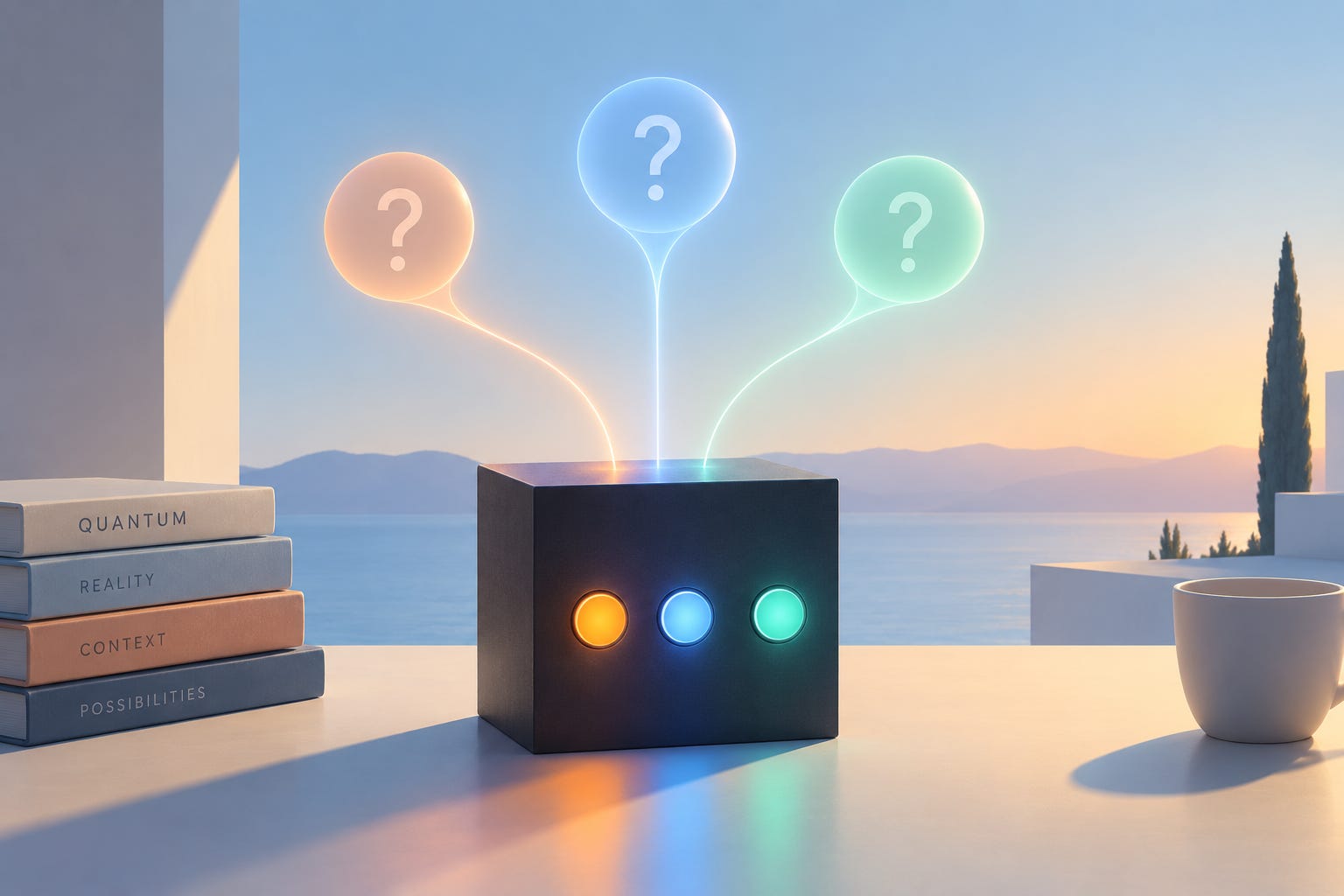
Suppose you own a very strange box.
It sits quietly on your table. Nothing moves. Nothing flashes. It is not connected to the internet, which already makes it unusual enough.
On the front are three buttons.
Ask the box question A and it gives you an answer. Ask B and it gives you another. Ask C and again it responds.
So far, so ordinary.
Now the trouble begins.
You discover that A can be asked together with B, and A can also be asked together with C. Naturally, you expect A to remain A. Why wouldn’t it? If the box has an answer to question A, surely that answer belongs to the box.
But quantum mechanics does not allow us to imagine, in general, that every possible answer was already sitting there in advance, independent of every possible set of questions in which A might appear.
At this point most of us would suspect the box is broken.
Quantum mechanics suspects our expectations.
We have a very strong habit of imagining reality as a collection of things carrying properties around with them. A stone has a mass. A car has a speed. A cup has a temperature. Measurement merely opens the drawer and reads what was already inside.
The quantum world is less fond of drawers.
It behaves more like a conversation in which the answer cannot always be detached cleanly from the way the question is framed.
This is not because the particle is confused.
It is not because your mind creates the answer.
It is not because reality waits anxiously for human attention.
The stranger possibility is more disciplined: some quantum properties cannot always be treated as if they had one context-independent value waiting to be revealed, regardless of which other compatible measurements are made alongside them.
That is a difficult idea because our language rebels against it. We say a particle has spin. It has position. It hasmomentum.
We like verbs of ownership.
Quantum mechanics keeps replacing them with relationships.
Perhaps that is why contextuality feels so slippery. It is not spectacular in the way tunnelling is spectacular. No particle walks through a wall. Nothing vanishes in one place and appears in another. There is no cat demanding media attention.
Instead, something quieter happens.
The grammar of reality begins to wobble.
Imagine asking someone, “Are you tall?”
Easy enough.
Now imagine that there is no meaningful answer unless you also specify: compared with whom?
A child?
A basketball player?
A skyscraper?
Of course, height itself is still ordinary and classical. The analogy is imperfect. But it catches the flavour: perhaps some quantum properties do not behave like little private possessions that can be specified once and for all, independently of context.
That feels less like discovering a thing and more like entering into a relation with it.
And this is where quantum mechanics becomes mischievous again.
We want to believe that every possible question already has an answer stored somewhere, even if we never ask it. Reality, in this picture, is a completed form waiting to be filled in by measurement.
But what if some blank spaces are not blank because we failed to look?
What if they were never independent questions to begin with?
This is the point where the concept becomes almost playful.
Suppose nature owns no master answer sheet.
Suppose there is no cosmic spreadsheet with rows for every particle and columns for every possible property, all filled in from the beginning of time.
Suppose instead that some answers only become definite within a particular arrangement of compatible questions.
Not arbitrary.
Not invented.
But contextual.
That one word changes the mood completely.
Because once context matters, our neat picture of objects carrying complete identities begins to soften.
The particle is still there.
The apparatus is still there.
The mathematics remains brutally precise.
But the question “What does the particle really have?” starts sounding suspiciously like the wrong question.
Perhaps the lesson is not that reality dissolves into subjectivity, but that reality cannot always be described as things plus context-free properties.
At least some quantum facts seem inseparable from the encounters in which they are defined.
Now consider a chessboard. A square is black or white regardless of which other square you look at. The board contains all its answers simultaneously. You can walk away and return tomorrow; nothing about the logical structure changes.
Now imagine a board for which you cannot consistently assign every square its colour independently of which larger pattern you choose to inspect.
That would feel less like uncovering a prewritten board and more like participating in one.
Quantum contextuality has something of that flavour.
And unlike some of the stranger corners of quantum foundations, this is not merely philosophical decoration. Experiments have tested quantum systems in ways that rule out broad classes of noncontextual hidden-value models.
More intriguingly, the weirdness may be useful.
In some models of quantum computation, contextuality is not merely present in the strange behaviour; it becomes part of the resource that makes certain quantum processes hard to simulate classically.
That is a fascinating reversal.
For centuries, technology advanced by making the world more predictable. We isolated systems, removed ambiguity, standardised components, forced electricity into clean zeros and ones. Reliability came from suppressing context.
Quantum technology may increasingly do the opposite.
Instead of eliminating the weirdness, we may learn to engineer it.
Superposition was once a philosophical embarrassment. Now we try to preserve it inside quantum processors.
Entanglement once looked like a paradox. Now we treat it as a resource.
Contextuality may follow the same path, moving from something that appears to undermine our picture of reality into something we deliberately exploit because classical machines cannot easily imitate it.
Perhaps future machines will not work by pretending every property exists independently, but by arranging measurement contexts so cleverly that the quantum system can do something no classical system can easily reproduce.
There is something almost comic about that.
For generations, engineers have tried to make machines less sensitive to context.
Quantum engineers may end up learning when to make context part of the design.
The weirdness becomes the feature.
And perhaps that is the most interesting thing about contextuality.
Not that reality is vague.
Not that anything goes.
But that our favourite picture of reality — objects carrying complete little dossiers of facts — may simply be too tidy.
We ask, “What property does the particle have?”
Quantum mechanics looks back and seems to ask:
“Under which question?”
And suddenly the object on the table does not look quite as self-contained as it did before.
Perhaps reality has always been less about what things are in isolation,
and more about what becomes definite when they meet.