

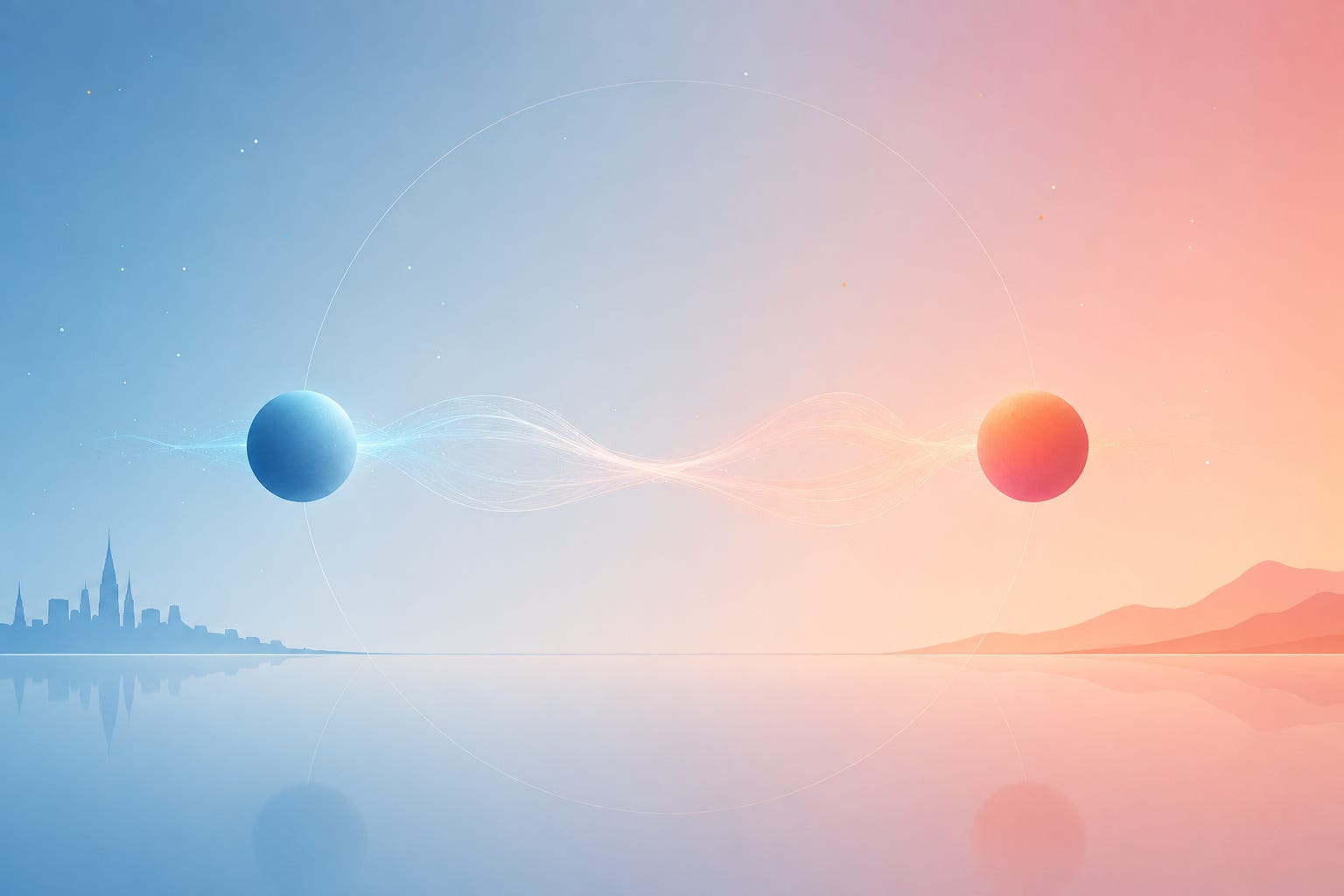
Imagine Alice stays in Brussels while Bob travels to the Moon. Before they separate, each receives one particle from an entangled pair. Much later, both perform measurements on their particle without communicating with one another.
When they finally compare their results, the pattern is unmistakable.
The measurements are correlated in a way that looks almost absurd. Two particles, separated by hundreds of thousands of kilometres, somehow behave as though the distance between them matters less than it should.
Our first instinct is obvious.
They must be communicating.
Something must pass from one particle to the other: a signal, a hidden instruction, an invisible whisper travelling faster than light. That would at least fit the way we understand the world. Things influence other things by sending something across the space between them.
Quantum mechanics refuses to give us that comfort.
Bob cannot detect a message. His own measurement results look random. Alice cannot choose her result and encode a message in it. Nothing useful travels from one side to the other, and no faster-than-light communication can be extracted from the experiment.
Only when Alice and Bob later compare their observations through an ordinary communication channel does the strange pattern become visible.
So perhaps the particles did not communicate at all.
Perhaps they already knew what to do.
That was the more comfortable escape route. Maybe both particles left their common source carrying a hidden set of instructions. If Alice measures this way, give this answer. If Bob measures that way, give another. Like two actors memorising the same script before walking onto different stages.
Einstein strongly preferred something along those lines. Quantum mechanics, he suspected, was incomplete.
Then John Bell found a way to test the idea.
If the particles merely carried local prearranged answers, there should be strict limits to the correlations they could produce. Quantum mechanics predicted correlations beyond those limits.
Experiments sided with quantum mechanics.
The particles do not behave as though they simply left home with matching instruction sheets.
And now the puzzle becomes much more interesting.
If they neither communicate nor carry all the answers in advance, what exactly is happening?
Perhaps the difficulty begins with the way we imagine the particles themselves.
We instinctively picture them as tiny independent objects. One is here. The other is there. Each possesses its own properties and follows its own history. If something happening here affects something there, then some influence must cross the distance in between.
That picture is so natural that we rarely notice we have imposed it.
Quantum mechanics does not.
An entangled pair is described by one joint quantum state. The particles can be physically separated and measured at different locations, yet the quantum description of the pair cannot always be broken into two complete independent descriptions.
Two particles.
One state.
That does not solve the mystery. In some ways, it makes it deeper.
Consider an ocean wave. We would not normally ask how one side of the wave informs the other side what to do. The wave is a pattern of the whole. Its behaviour is not best understood as a conversation between individual water molecules.
Entanglement tempts us toward a similar intuition, though the comparison quickly breaks down. An ocean wave is still thoroughly classical. Disturbances propagate locally through the water. Entanglement produces correlations that cannot be explained so easily.
Still, the analogy hints at something important.
Perhaps we are too eager to divide reality into independent pieces.
Our everyday world encourages us to do exactly that. Cups, trees, cars and people occupy different places and mostly behave as separate objects. At our scale, separation works astonishingly well as a way of organising reality.
But why should it remain fundamental at every scale?
Even time has already betrayed our intuition.
Relativity tells us that distant events do not always possess an absolute order. Two observers moving differently can disagree about which of two spacelike-separated events happened first.
That creates an awkward problem for the simple story in which Alice’s particle sends something to Bob’s.
In one reference frame, Alice may measure first.
In another, Bob does.
So which particle sent the message?
Perhaps the universe is not confused.
Perhaps the story is.
This is where the question becomes more speculative.
Some modern approaches to quantum gravity explore the possibility that spacetime itself may not be the deepest layer of reality. Geometry might emerge from more fundamental quantum relationships.
No one knows whether those ideas will ultimately survive.
But they invite a remarkable reversal.
We usually ask how entanglement can act across space.
Perhaps we should also ask whether space is as fundamental as we assume.
Maybe distance is not simply the stage on which quantum reality performs.
Maybe, at the deepest level, distance is part of the performance.
That does not mean that space is unreal, that particles live outside time, or that relativity has somehow failed. Alice’s detector is still in Brussels. Bob’s is still on the Moon. Signals still cannot be sent faster than light.
The more modest—and more unsettling—lesson is that spatial separation may not imply complete physical independence.
Here and there remain meaningful.
What quantum mechanics challenges is our instinct that here and there must therefore possess entirely separate stories.
We began by asking how two entangled particles communicate.
Perhaps that was the wrong question from the beginning.
Communication assumes two independent things, each possessing information of its own, sending something across the gap between them.
Entanglement seems to give us something stranger: two separated objects whose relationship cannot be reduced to two independent local descriptions.
Maybe nothing crosses the distance because the relationship was never located on either side of it.
And perhaps that is why entanglement remains so unsettling.
Not because particles whisper faster than light.
But because they force us to wonder whether the boundaries we instinctively draw around things belong as much to us as they do to nature.
The particles may never have needed to talk.
We were simply convinced that they should.