

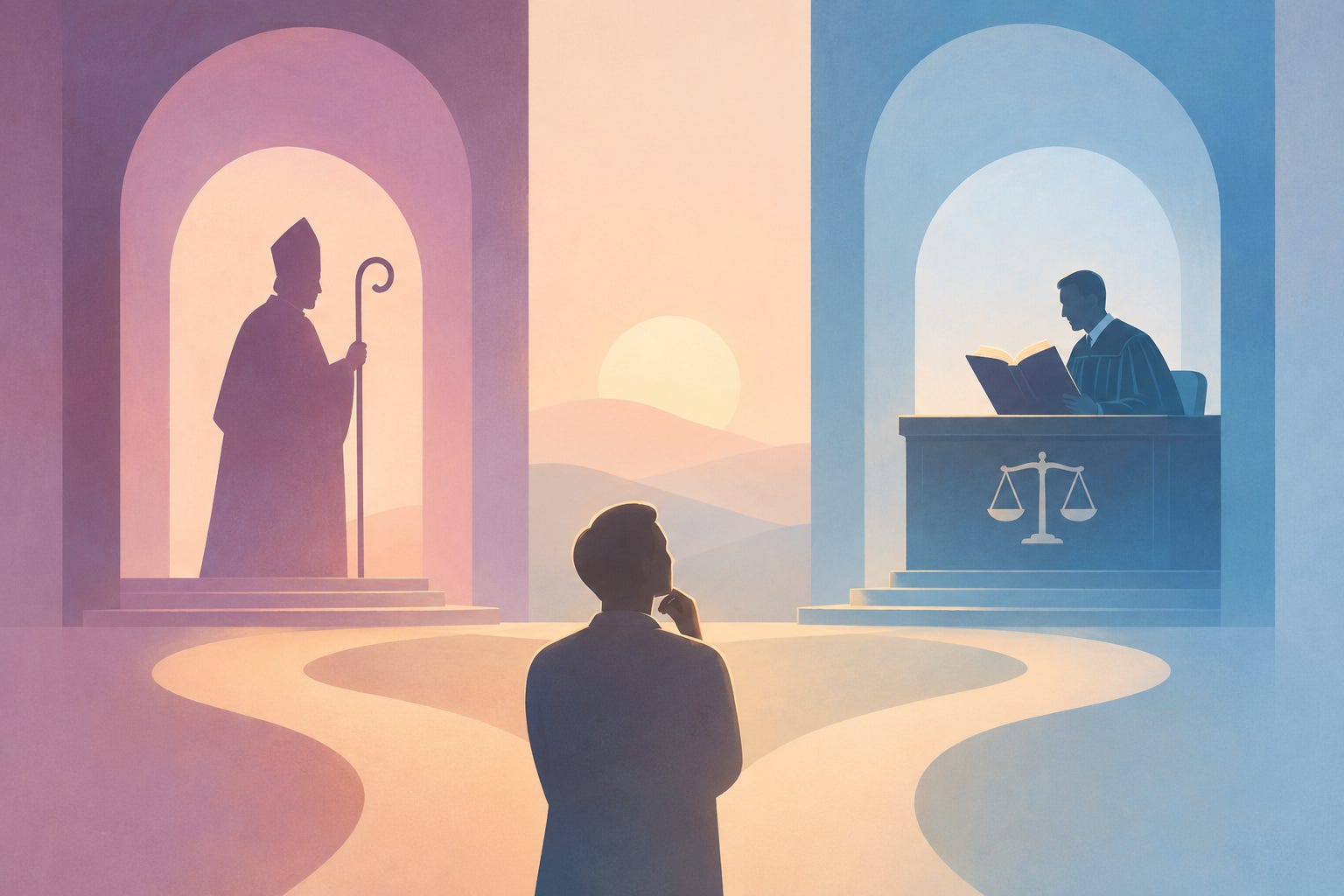
When the Lawyers Became the Priests
The recurring temptation to turn human interpretation into unquestionable moral authority
For centuries, religious institutions claimed a privileged authority over morality. They determined what was right and wrong, developed elaborate doctrines to explain their judgments, and established a professional class of interpreters who spoke with an authority ordinary people could rarely challenge. Religious principles became institutional rules, interpretations became obligations, and disagreement could easily become heresy.
The Enlightenment, scientific progress, and the emergence of secular democracies gradually challenged this arrangement. We learned to question the authority of religious institutions and rejected the idea that a particular group should possess exclusive access to moral truth.
Or at least we thought we had.
Perhaps the underlying problem was never religion itself, but something more deeply rooted in human societies: our remarkable tendency to create abstract principles, establish institutions to interpret them, and eventually treat those interpretations as truths that should no longer be questioned.
We may have diminished the authority of the priest without overcoming our appetite for priesthood.
The New Moral Authorities
In modern democracies, legal institutions have acquired an increasingly prominent role in determining what societies consider morally acceptable. Constitutional courts, international tribunals, and specialized legal organizations interpret principles such as equality, dignity, freedom, and discrimination, often resolving controversies that reach far beyond purely legal questions.
There are excellent reasons for granting courts such authority. Fundamental rights must protect individuals against arbitrary governments and majorities that might otherwise disregard their freedoms. Independent courts are indispensable to constitutional democracy.
But a less comfortable question remains. Does expertise in law also confer superior authority in matters of morality?
Lawyers understand legislation, judicial precedents, and legal reasoning. That expertise is valuable, but it does not necessarily provide greater insight into social realities, economic consequences, human behavior, or the competing moral values of citizens. Yet once a dispute enters the legal domain, these other perspectives must often accommodate the categories and interpretations established by the legal profession.
And the system tends to reinforce itself. Legal interpretations generate precedents, precedents generate doctrines, and doctrines require increasingly specialized expertise. The authority of professional interpreters grows alongside the complexity of the structures they maintain.
Politicians frequently assist this development by transferring difficult decisions to courts, allowing them to avoid responsibility for controversial choices. What emerges is not necessarily a deliberate seizure of power, but a gradual redistribution of moral and political authority away from democratic debate.
When Human Rights Become Beyond Question
Human rights offer perhaps the most revealing illustration, precisely because their original purpose is so important.
The Universal Declaration of Human Rights, adopted in 1948, expressed humanity’s determination to protect individuals against the atrocities and abuses of unchecked power. Its principles of human dignity, equality, and fundamental freedom became an essential foundation for modern constitutional and international law.
Few would seriously argue that governments should be free to torture citizens, arbitrarily imprison opponents, or deny basic human dignity. Such protections are among the great achievements of modern civilization.
But there is an enormous difference between accepting a universal principle and accepting every interpretation subsequently developed in its name.
Equality, for example, sounds straightforward until we must decide whether it requires equal treatment, equal opportunities, or measures intended to correct unequal outcomes. Freedom of expression becomes considerably more complicated when it conflicts with protection against discrimination. Privacy, security, personal autonomy, and collective welfare frequently pull in different directions.
These are not questions that abstract principles can resolve automatically. They require human judgment, choices between competing values, and an understanding of consequences.
Indeed, the original Declaration recognized that rights must be exercised with consideration for the rights of others and the general welfare of democratic society.
Yet as human rights become embedded in increasingly elaborate legal frameworks, something subtle can happen. Particular interpretations begin to acquire the unquestionable moral authority of the principles they were intended to implement.
Question a specific interpretation of equality, and you risk being portrayed as opposing equality itself. Challenge a policy justified through human rights, and your objection may be dismissed as hostility toward human rights.
The authority of the principle becomes a shield for the authority of its interpreters.
This is where the historical comparison becomes uncomfortable. Religious institutions once claimed privileged authority to interpret sacred principles. Modern legal institutions operate on fundamentally different foundations, but they can face a similar temptation: treating their interpretation of a moral principle as though it possessed the same unquestionable authority as the principle itself.
The problem is not human rights. It is the gradual disappearance of the distinction between a universal moral commitment and the human judgments made in its name.
When Disagreement Becomes Heresy
Democracy was never intended to produce universal agreement about morality. It provides a way for people with different values, experiences, and interests to live together, negotiate competing priorities, and make collective decisions despite their disagreements.
Fundamental rights necessarily place limits on majority decisions. But those limits do not eliminate legitimate disagreement about how rights should be interpreted, balanced, and implemented.
When institutions treat particular moral interpretations as beyond question, democratic disagreement can take on a very different character. Opponents are no longer simply people who reach different conclusions. They risk becoming people whose views are considered morally unacceptable. Arguments about effectiveness, proportionality, or unintended consequences are displaced by arguments about who stands on the morally correct side.
This dynamic is not restricted to lawyers or judges. Political movements, activists, administrators, and ordinary citizens can display the same conviction that their moral worldview deserves precedence over competing perspectives.
But when institutions backed by public authority adopt this attitude, the consequences can extend much further. Citizens who feel their concerns are dismissed may begin to regard those institutions as disconnected from the society they supposedly serve. Institutional representatives, confronted with growing resistance, may interpret that resistance as further evidence that their principles require stronger protection.
The resulting confrontation can reinforce polarization. One side increasingly sees institutional authority as arrogance; the other increasingly sees democratic resistance as a threat to fundamental values. And in the process, the distinction between challenging a particular exercise of authority and rejecting the underlying principles can disappear altogether.
The Priesthoods We Keep Creating
Human societies need abstract principles. Without them, there could be no stable legal system, meaningful rights, or shared foundations for collective life. Nor should the protection of fundamental freedoms depend entirely on the shifting preferences of political majorities. But principles do not interpret themselves. Human beings do, bringing their knowledge, assumptions, experiences, priorities, and inevitably their limitations.
The danger begins when institutions gradually forget that distinction. It is entirely legitimate for a court to enforce constitutional rights against an elected government. It is something else to suggest that every interpretation developed within the legal system should enjoy immunity from moral or political criticism simply because it invokes those rights. No profession, institution, or political movement possesses exclusive authority over moral truth. Expertise deserves respect, and legitimate legal judgments must be observed, but neither expertise nor legal authority confers infallibility.
Perhaps the most revealing lesson of our history is how little this temptation has changed. We repeatedly create principles intended to improve society and develop institutions to safeguard them. Then we gradually allow those institutions to claim an authority extending beyond the principles themselves.
We spent centuries challenging the authority of priests, only to discover that we have a remarkable talent for creating new priesthoods.
The problem was never simply who claimed to possess the truth. It was what happened when their authority made questioning that truth increasingly unacceptable.