

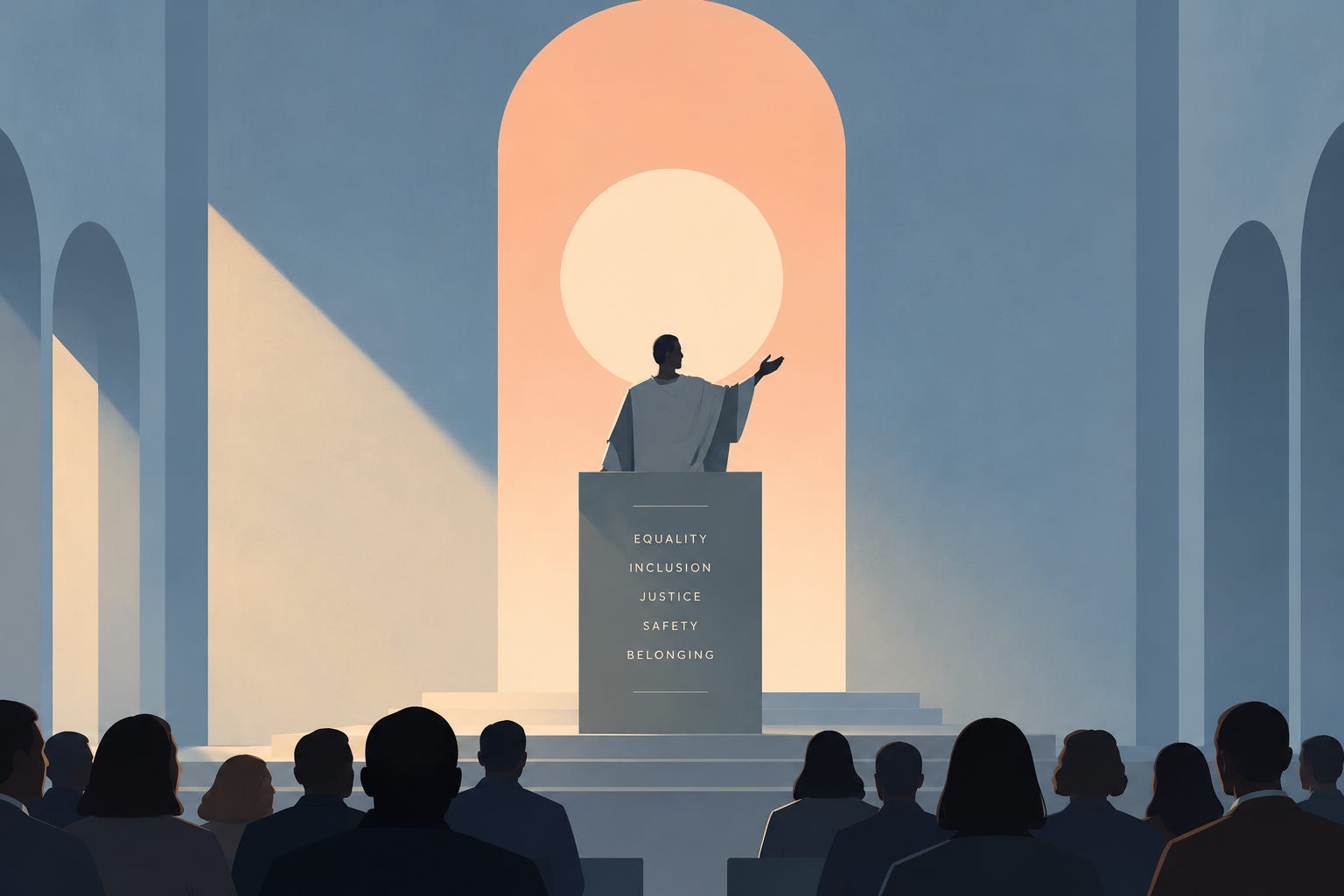
There is a puzzle at the heart of modern Western egalitarianism that I don’t think gets enough attention. A lot of the people most committed to talking about privilege are themselves pretty privileged — not necessarily billionaire privileged, but university-educated, professionally secure, culturally connected, living in good neighbourhoods and quite skilled at navigating institutions. In other words, they may not own factories, but they have credentials, networks and influence. And those things matter a lot.
This does not mean they are hypocrites. In fact, I suspect hypocrisy explains less than people think. Most probably do believe what they say. They genuinely dislike poverty, discrimination and inherited disadvantage. But people are much better at spotting somebody else’s privilege than their own, partly because our own advantages usually come with respectable explanations attached. The businessman’s money looks like privilege; the professor’s degree looks like merit. The businessman remembers the risks he took and forgets the family connections that helped him. The academic notices inherited capital but is less likely to think of growing up in a house full of books, knowing how universities work and having parents who could support years of education as inheritance too.
This becomes even more interesting once you add emotions. Compassion obviously matters, and so does a sense of fairness. But envy matters as well, though nobody particularly wants to say so. The important thing about envy is that people compare themselves mostly with people close to their own status. A professor probably isn’t comparing his income with someone stacking shelves at Carrefour; he is comparing it with a corporate lawyer, banker or CEO. So you can easily be somewhere in the top part of society and still experience inequality mainly by looking upward. At the same time, admiration can push in the other direction: instead of asking why someone else has more, you ask how they got there. A decent society probably needs both instincts — enough suspicion to stop wealth turning into inherited power, but enough admiration to avoid treating every large difference in outcome as evidence of injustice.
And then there is self-interest, which becomes visible as soon as equality stops being theoretical. Almost everybody supports affordable housing until it gets proposed next door. Almost everybody supports equality of opportunity, but parents still spend time, money and contacts giving their own children every advantage they can. That is not some great moral failure; it is what parents do. But it does tell us that equality becomes a lot more complicated once it reaches the things we personally value.
The professional class matters here because it doesn’t just participate in these debates; it often writes the rules. Academics create concepts, journalists popularise them, administrators turn them into policy and professional organisations turn policy into standards. If you have worked in a large organisation, you know how this goes. Somebody announces a principle nobody can reasonably oppose — fairness, inclusion, safety, quality. Then somebody has to define it, somebody else has to measure it, reports appear, exceptions are discovered, procedures multiply and eventually the original principle has become a fairly elaborate control system. Nobody necessarily planned it that way. Each step looked perfectly reasonable when it was introduced.
Equality is particularly powerful in this respect because it carries moral force. If a quality-management procedure is stupid, people will eventually call it stupid. If a rule is introduced in the name of justice, challenging it is harder, because suddenly you are not merely criticising a procedure; you may appear to be criticising justice itself.
This is where I think a much larger Western change matters. For most of European history, churches openly claimed moral authority. They told people what was right and wrong, often in far too much detail, and they claimed a source of authority above ordinary politics. The West spent a very long time reducing that power, and mostly for good reasons. But this is a specifically Western development. In large parts of the world, religion still provides strong social and sometimes political authority. What is unusual about contemporary Western Europe, and increasingly some other Western societies, is that traditional religious authority has weakened dramatically without any obvious successor being accepted as the legitimate moral referee.
The need for morality did not disappear, of course. People did not become amoral when they stopped attending church. What changed is that moral authority became dispersed. Universities have some of it, courts have some, professional bodies have some, NGOs have some, journalists have some, activists have some, and increasingly large organisations develop their own moral codes through HR, compliance and institutional policy. Nobody is formally in charge, but quite a few people behave as though some questions are already morally settled.
That produces a strange situation. The old priest at least said openly that he was making a moral claim. Modern institutions often present moral claims as administration. The university has a guideline. The company has a policy. The professional body has updated its standards. The language sounds procedural, even when the question underneath is something as basic as what people may say, what counts as harm or which differences between people are acceptable.
Some of this is entirely reasonable. Organisations obviously need rules, and expertise matters. If a psychologist has spent twenty years studying discrimination, I would rather hear from that person than from somebody who watched three YouTube videos. But expertise about a problem and authority to decide which values should dominate are not the same thing. An economist can tell us what a tax will probably do; that does not mean the economist gets to decide how much redistribution is morally desirable. A psychologist can tell us something useful about prejudice; that does not automatically answer how far restrictions on speech should go.
That boundary gets blurry surprisingly quickly, especially for people whose position already depends on expertise. “I know more about this problem than you do” may be completely true. “Therefore I should decide what everyone must do about it” is a separate claim.
And this is where good intentions can become dangerous. Power exercised for obvious personal gain is easy to recognise. Power exercised in the name of vulnerable people often feels different to the person exercising it. It feels moral. And once a policy is identified with justice itself, resistance starts to look suspicious: maybe the person objecting simply does not understand, or is defending privilege, or is part of the problem the policy was designed to fix.
At that point you get something the West should recognise from its religious past: the temptation to conclude that being morally right gives you authority over people who disagree.
The irony is that we spent centuries learning to distrust exactly that move.
This is why I think the interesting question about modern defenders of equality is not whether they are sincere. Many plainly are. The question is which inequalities they notice and which ones have become invisible to them. Financial inequality is easy to see. The advantages embedded in education, professional licensing, cultural influence, property ownership and the ability to pass all of this to your children are less obvious if you happen to possess them.
So perhaps the real test of an egalitarian principle is what happens when it reaches home. It is fairly easy to support redistribution from billionaires. It gets harder when the issue is the value of your own house, the exclusivity of your profession, the importance of your degree or the advantage you hoped your children would inherit.
That does not make equality a bad ideal. Equality before the law is fundamental, and societies that allow inherited privilege to harden indefinitely eventually become stagnant and angry places. But equality is only one value among several. Freedom matters. Merit matters. Responsibility matters. Tolerance matters. And in a society without a single accepted moral authority, perhaps one principle matters even more: people who are convinced that they are right still need to accept limits on how much they can impose on everyone else.
The West did not get rid of religious authority in order to discover that it needed a new priesthood. The more interesting challenge is learning how to live without one.