

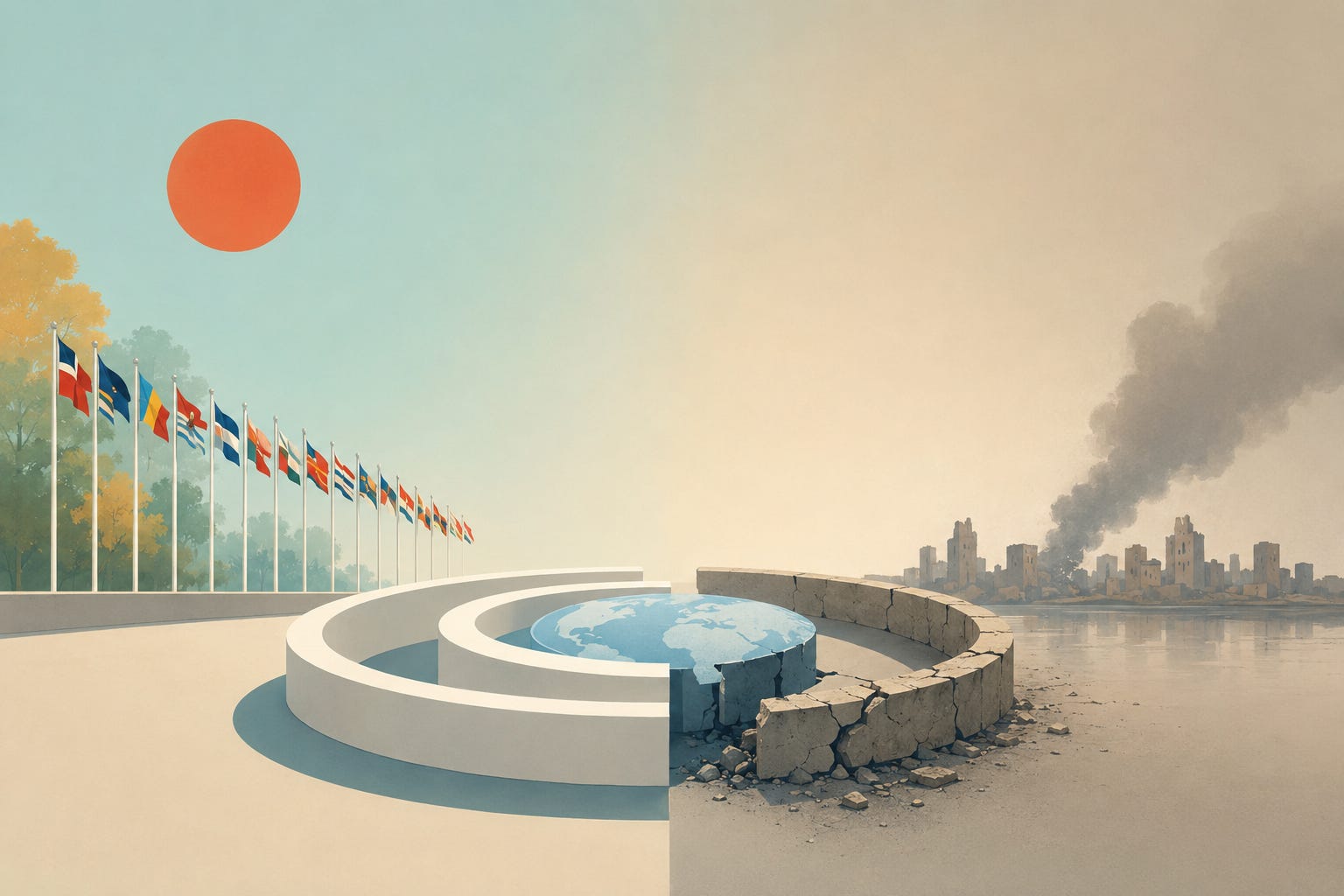
The International Order Did Not Fail Because It Was Too Weak. It Failed Because It Lied to Itself.
The great international institutions of the last century were born from horror. After the First World War, the League of Nations promised that civilized countries would no longer sleepwalk into slaughter. After the Second World War, the United Nations promised that humanity had finally understood the lesson. War would perhaps not disappear completely, but it would be contained. Aggression would be named. Diplomacy would be structured. Rules would replace raw force. The jungle of international relations would be disciplined by procedure, law and permanent dialogue.
It was a beautiful thought, but also a dangerous illusion.
During the last hundred years, we built an impressive architecture of international order: the UN, IMF, World Bank, WTO, NATO, EU, endless agencies, courts, councils, missions, programmes, conferences and declarations. That architecture achieved more than nothing. It would be unfair to deny that. Some coordination improved, some crises were softened, some vaccines arrived, some refugees were fed, some standards made the world work more smoothly, and some wars were delayed, limited or frozen.
But the central promise was far larger than technical coordination or humanitarian relief. These institutions were not created merely to write reports, host summits and issue statements of deep concern. They were supposed to bring order into international chaos. They were supposed to make war less likely. They were supposed to make relations between states more structured, more predictable and less brutal. On that central promise, the record is miserable.
War did not disappear. Aggression did not disappear. Genocide did not disappear. Imperial ambition did not disappear. Corruption did not disappear. Strongmen did not disappear either. They merely learned when to use the language of institutions, and when to ignore it.
The League of Nations collapsed because it could not stop the powers that mattered. The United Nations survived because it accepted that it could not stop the powers that mattered. That is often described as realism, and perhaps it was, but it also means that paralysis was built into the machine from the beginning. The Security Council can act when the great powers agree. When they do not, it becomes theatre. Speeches are made, draft resolutions circulate, humanitarian language is polished, outrage is carefully performed, and meanwhile the dead remain dead. The institution continues, while the mission fails.
That pattern has repeated itself for decades.
International institutions rarely die from failure. They absorb it. They convert failure into new mandates, new reports, new departments, new working groups, new budgets, new conferences and new careers. A national government can be voted out. A company can go bankrupt. A military can lose a war. But an international bureaucracy can fail for decades and still emerge asking for more resources to continue the work. This is how mission becomes self-protection, and how self-protection slowly becomes self-indulgence.
Over time, the international bureaucracy has developed a magnificent language for avoiding reality. Failures become “implementation gaps.” Paralysis becomes “lack of consensus.” Impotence becomes a “complex operating environment.” Corruption becomes a “governance challenge.” Institutional irrelevance becomes “the need for renewed commitment.” This language is not innocent. It is the padded cell in which responsibility is locked away.
The worst mistake of the international order was not idealism. Idealism can be useful. The worst mistake was pretending that moral language could substitute for power, that procedure could substitute for will, and that declarations could substitute for enforcement. A resolution does not protect anyone by itself. A communiqué is not peace. A framework is not courage. A mandate is not capability. A summit is not an achievement.
The world did not become peaceful because diplomats learned to write better paragraphs. The world remained peaceful where power, deterrence, prosperity and mutual fear made war unattractive. Elsewhere, the institutions often arrived after the damage had been done, and then stayed to manage the rubble. That is the uncomfortable truth. Much of the international system did not prevent catastrophe. It became a professional manager of catastrophe.
This is especially visible in aid.
Aid began as compassion, reconstruction and development. At its best, it saved lives, rebuilt infrastructure and reduced suffering. But aid also created one of the great moral evasions of modern international politics. Money was sent into broken states as if money itself could repair broken politics. Food, loans, grants, expertise, technical assistance, budget support and humanitarian programmes entered places where power was already captured by clans, parties, armies, militias, presidents-for-life and well-dressed thieves. Then everyone pretended to be surprised when much of it disappeared.
Aid in corrupt systems does not merely leak away. It changes the system. It becomes part of the political economy. It rewards access, strengthens brokers, feeds patronage and allows regimes to neglect their own citizens while foreign donors pay for the basics. It allows elites to steal nationally while posing internationally. It allows governments to fail domestically while performing victimhood abroad.
Worse still, aid often creates entitlement without responsibility. The receiving elite learns to speak the language of need, trauma, colonial guilt, development goals and global justice. The donor elite learns to speak the language of solidarity, partnership and impact. Between them grows an industry in which everyone is morally well-dressed and very few are accountable for results. The people who genuinely need help are often the last link in the chain.
When war comes, the absurdity becomes even darker. Roads, schools, hospitals, power stations, water systems, offices and institutions financed by foreign taxpayers are destroyed by conflicts the international institutions failed to prevent. Afterwards, new conferences are organized to finance reconstruction. The same actors promise “never again,” the same region remains unstable, the same corruption returns, and the same strongmen learn the most useful lesson of all: violence pays twice, first in power and then in reconstruction money.
In some regions, aid did not defeat the strongman. It helped build him. Money meant for development became money for networks. Money for networks became money for control. Control became repression. Repression became rebellion. Rebellion became civil war. Civil war became humanitarian crisis. Humanitarian crisis became more aid. The circle closed almost perfectly.
None of this means that aid should never exist. That would be a childish conclusion. In a rich world, refusing help to people in genuine disaster would be morally obscene. But the opposite childishness is even more common: assuming that sending money is inherently virtuous, that good intentions survive bad systems, and that compassion does not require hard questions. Aid without accountability is not solidarity, but a subsidy for dysfunction. Aid without political realism is not development, but theatre. Aid that strengthens corrupt power is not humanitarian, but dangerous.
The international institutions largely failed to confront this because confronting it would also mean confronting themselves. Their own budgets, mandates, careers and reputations depend on the continued existence of the problems they claim to solve. Poverty, displacement, war, underdevelopment and instability are not only tragedies. They are also institutional ecosystems. That is a brutal sentence, but it needs to be said.
Over the decades, the international order became too comfortable with managing misery. It built expertise around failure. It learned to measure activity rather than outcome. It counted programmes, not transformed societies. It celebrated commitments, not peace. It confused compassion with competence.
Meanwhile, citizens in donor countries began to notice the contradiction. They were told that international institutions represented civilization, responsibility and order, but they saw endless war, endless migration pressure, endless corruption, endless conferences, endless bills and very little accountability. They saw money leave, problems remain, and lectures return.
Into that disappointment walks the strongman.
The strongman says that there has been enough complexity, enough talk, enough experts, enough globalism, enough weakness. He promises directness, sovereignty, borders, pride and control. He promises to cut the knot. But complex societies cannot be governed by cutting knots. They are governed by understanding them.
This is where the strongman’s great lie begins. He is often correct about institutional decay. He is often correct that bureaucracies hide behind language, that elites became detached, that aid can feed corruption, that trade can destroy local industries, that migration can strain trust, that rules are applied hypocritically, and that international law often bows before power. His diagnosis contains enough truth to be politically explosive, but his cure is poison.
The modern world is not simple. It is the richest, most complex and most interdependent structure humanity has ever built. Food, energy, finance, chips, medicines, logistics, climate, water, data, telecom, aviation, migration, defence, cyber security and public health now cross borders constantly. No ruler, however loud or self-confident, can master that complexity by shouting at it.
The only serious way to manage complexity is cooperation, but not the sentimental cooperation of glossy summits and ambitious targets for 2050. What is needed is practical, accountable cooperation that admits trade-offs, punishes corruption, understands power, respects democratic consent and stops pretending that all regimes, cultures and institutions behave in the same way.
The strongman does the opposite. He simplifies, centralizes and personalizes. He turns institutions into loyalty machines, treats disagreement as sabotage, and replaces knowledge with instinct and expertise with obedience. This may look efficient for a while, especially on television, but it destroys the delicate complexity that makes modern society rich.
A complex society is not a barracks. It cannot be commanded into excellence. It needs trust, distributed competence, independent institutions, honest feedback, free inquiry, reliable law, technical expertise, local initiative and enough humility to let reality correct policy. Strongmen hate most of that. They prefer applause to feedback and loyalty to competence. That is why they eventually rot the systems they claim to save.
So we are trapped between two failures. On one side stands the international bureaucracy, bloated with rules, procedures, careers, moral vanity and endless self-protection. On the other side stands the strongman, selling primitive control as an answer to complex failure. Neither is good enough.
The international order of the last century failed because it drifted too far from reality. It mistook meetings for action, aid for development, declarations for courage and institutional survival for success. But the answer is not to abandon cooperation. The answer is to make cooperation serious again.
That means fewer illusions, less moral theatre, less money poured into corrupt systems, less tolerance for institutions that fail upward, and less worship of abstract rules that nobody can enforce. It also means more accountability, more realism, more respect for national democratic consent, more attention to outcomes and more willingness to say, plainly, when something does not work.
The world needs institutions, but not institutions that float above reality in a cloud of paperwork and self-congratulation. It needs institutions that know what they can do, admit what they cannot do, and stop pretending that every failure is merely another reason for a larger mandate.
The twentieth century tried to civilize power through institutions. The twenty-first century is discovering that institutions without realism become bureaucracy, while power without institutions becomes brutality. The task now is not to choose between the two. The task is to rescue cooperation from bureaucracy before the strongmen bury it completely.