

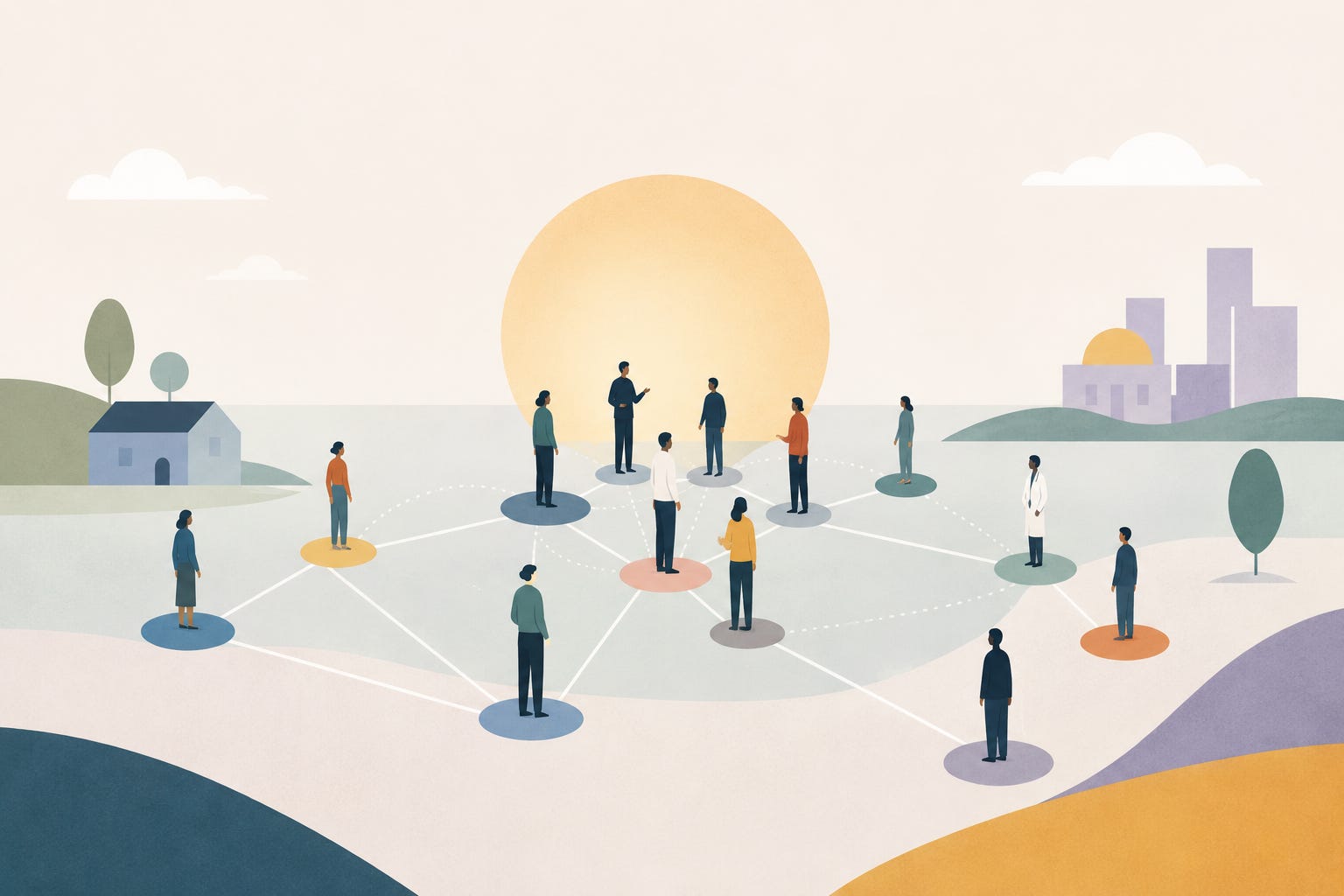
What If Government Learned Instead of Controlled?
The previous post ended with a simple question. When a policy produces disappointing results, what if the failure is not merely telling us that execution was poor? What if it is telling us something about the policy itself?
That sounds obvious, but most public institutions are not really organised that way. Information still travels mainly upward through reports, indicators and summaries, while decisions travel downward through laws, procedures and instructions. When the results disappoint, the usual instinct is to strengthen the chain: better reporting, clearer rules, tighter control.
Perhaps the problem is that the chain itself is too narrow for the complexity it is trying to govern.
Communication Can Create Knowledge
I learned something about this long before thinking about politics. During years of managing software support and critical customer situations, I would often prepare for an important customer visit by studying everything available in our systems: case histories, technical notes, previous actions and hypotheses. By the time I arrived, I usually felt that I understood the problem reasonably well.
Then I sat down with the customer, and the picture almost always changed.
Someone mentioned a detail that had never made it into the case history. A technical specialist described an interaction that had seemed irrelevant earlier. One question triggered another, and suddenly two observations that had lived in separate parts of the organisation connected. Quite often the outline of a solution began to emerge during the conversation itself.
The data had not necessarily been wrong. They had been incomplete. More importantly, some of the understanding needed to solve the problem did not exist anywhere before the discussion. It was created by the interaction.
That distinction matters.
We tend to design organisations as if communication mainly transports information that already exists. Somebody observes something, reports it upward, somebody else analyses it, and a decision returns downward. But difficult problems often require different partial views to meet before the real problem becomes visible.
A teacher sees what happens in the classroom. A policymaker sees patterns across thousands of schools. A parent or pupil may experience something that neither perspective captures fully. Keep those views in separate layers and each remains partially blind. Bring the relevant people together around the actual problem and something new can emerge.
That is more than feedback.
It is distributed intelligence.
Hierarchy Should Not Be the Only Route
Government cannot simply replace hierarchy with informal networks. Politics deals with conflicting interests, legal rights and public money. Somebody still has to decide, and somebody has to remain accountable.
But hierarchy does not need to be the only route through which knowledge travels.
Some things genuinely require common rules. Others depend so heavily on local circumstances that detailed central prescription quickly becomes clumsy. The challenge is not to choose between centralisation and decentralisation in the abstract, but to understand where consistency is essential and where local judgement contains information the centre cannot possess.
The same applies to standards. Standardisation works extremely well when reality repeats itself reliably. Checking the identity of a patient before surgery should not depend on personal judgement. Technical interfaces need common specifications. Basic financial controls should not be reinvented locally.
Problems begin when that logic expands into areas where the important details keep changing.
A curriculum can define what pupils should learn, but it cannot determine the best response to every classroom. A medical protocol can guide treatment without anticipating every patient. A legal procedure can protect rights without eliminating the need for judgement.
Even the word standard can become another Babel abstraction. Governments may claim to prescribe only quality, safety or inclusion, while those concepts then generate an entire machinery of indicators and proof requirements.
So the useful principle is not simply “set standards and decentralise execution.”
It is closer to this: standardise what is genuinely stable and understood; preserve judgement where reality remains variable.
Let the Problem Shorten the Organisation
There is another danger. A call for better communication can easily produce more meetings, consultation and reporting.
That would make things worse.
A distributed system should shorten communication paths, not add another layer to them.
In serious customer situations, we often allowed the problem to determine who needed to talk to whom. The relevant specialists joined, the customer participated directly, and management remained involved where priorities or resources mattered. People did not need to climb and descend the hierarchy every time they discovered something important.
Public institutions could use much more of that behaviour.
A difficult education problem might temporarily bring together teachers, school leadership, policymakers, researchers and parents. A healthcare bottleneck might involve clinicians, administrators, IT specialists and patients. Once the issue becomes understood and routine, the temporary structure can disappear.
The point is not that everybody should talk to everybody.
It is that the organisation chart should stop deciding every conversation.
And better communication should replace some bureaucracy, not sit on top of it.
Policy Should Be Able to Learn
A learning government would also need to stop treating every policy as a finished product.
Some things need stability. Citizens and businesses cannot function if taxes, rights or fundamental rules change constantly. But implementation mechanisms need not acquire the same permanence as the objectives they serve.
A right can remain stable while the procedure used to deliver it changes. An educational objective can remain clear while schools try different ways of reaching it. A safety requirement can remain fixed while the technical method evolves.
This distinction matters because politics often makes implementation choices almost as difficult to reverse as the goals themselves. Changing the method then looks like admitting that the policy failed.
A learning system would treat revision differently.
If implementation reveals something unexpected, the first response would not automatically be another instruction. Sometimes the frontline needs to change. Sometimes the original assumption needs to change.
The centre has to be capable of losing that argument occasionally.
And so does the frontline.
A teacher, hospital or municipality can also be wrong. Local autonomy is not automatically wisdom. The wider system may see patterns that no local actor can see.
Neither side owns reality.
Babel Does Not Need Another Tower
Perhaps that is the constructive lesson of the series.
The answer to complexity is not an all-knowing centre. No centre can contain enough detail. But neither is the answer to scatter authority and hope that thousands of local decisions somehow produce coherence.
What needs to change is the architecture connecting them.
Knowledge has to move upward, downward and sideways. People implementing policy need direct ways to reach those designing it when reality exposes a problem. Citizens sometimes need to enter the conversation instead of existing only as statistics. Stable processes should be standardised without turning every abstract objective into another compliance system. Local variation should sometimes be corrected and sometimes studied.
Most importantly, institutions have to recognise that understanding is not always information waiting somewhere to be collected.
Sometimes nobody has the answer yet.
It appears only when different fragments of reality meet.
The old Babel collapsed because people could no longer understand one another.
Our modern Babel may suffer from the opposite problem: we have extraordinary communication technology, yet too much of our institutional intelligence still has to travel through the tower.
Perhaps the next step is not to build a better tower.
It is to build a better network.