

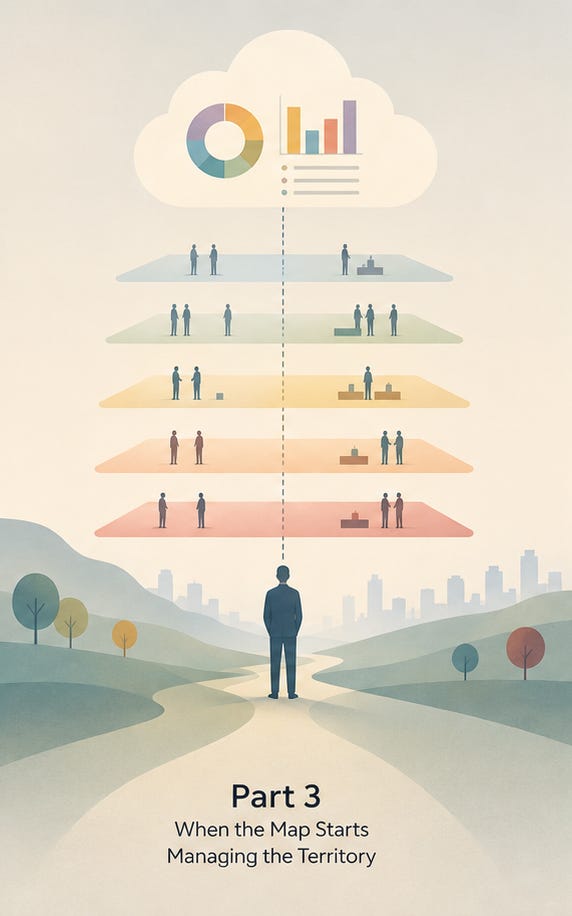
When the Map Starts Managing the Territory
The previous post ended in a classroom, with a teacher confronting the part of education policy that could never have been written into the policy itself. No matter how intelligently the experts had worked, how carefully their different perspectives had been integrated or how precisely everyone had agreed on the meaning of inclusion, quality and equality, twenty-six particular children arriving on one particular Tuesday morning immediately added information that had not existed when the plan was made.
That left us with a rather awkward conclusion. A complex organisation cannot simply analyse reality, turn that analysis into a plan and then regard implementation as execution. Reality keeps changing, and implementation itself creates new knowledge. Somehow that knowledge must find its way back into the organisation.
This sounds obvious until we look at what actually happens when organisations become large.
Imagine the management meeting of a major hospital. Nobody around the table can possibly visit every ward, meet every patient or observe every treatment. Nor should they. The hospital may treat thousands of people every week, employ several thousand staff and operate dozens of highly specialised departments. Management therefore needs another way of knowing what is happening.
The hospital produces numbers.
Waiting times, infection rates, occupancy levels, readmissions, staffing ratios, treatment outcomes, incidents, budgets and patient-satisfaction scores gradually replace the impossible task of experiencing the hospital directly. The figures are indispensable. Without them, management would be flying blind.
Yet something happens during that translation. The elderly patient who waited five hours while frightened and confused becomes part of the average waiting time. The nurse who quietly prevented a medication error becomes invisible because nothing happened. The surgeon who postponed an operation because something did not feel right may appear less productive than the colleague who completed the schedule. Thousands of immensely complicated human stories become a manageable collection of indicators.
Nothing dishonest has happened.
Reality has simply been compressed.
The Necessary Art of Losing Information
Every large organisation has to do this. There is no alternative.
A government cannot invite millions of citizens into the cabinet room to explain how every regulation affects them. A multinational cannot put every customer beside the CEO. A university rector cannot attend every lecture, and a minister of education cannot spend Tuesday morning in every classroom.
The organisation survives by turning reality into representations that can travel.
A customer conversation becomes a sales report. Several reports become a regional summary. The regional summaries become a dashboard. The dashboard becomes three slides in an executive presentation, and eventually an enormously complicated market may arrive in the boardroom as a red arrow pointing downward beside the words customer satisfaction.
At each stage, the representation becomes easier to handle precisely because it contains less reality.
That is not a criticism of management. It is one of management’s unavoidable tasks. The CEO who insists on reading every customer complaint personally would soon become useless as a CEO. The minister who wants to investigate every individual school problem would no longer have time to govern the education system.
Abstraction is what allows complex organisations to exist.
The danger begins when we forget that abstraction works by throwing information away.
This sounds almost too obvious to mention. A map of Belgium that showed every tree, lamppost and paving stone would cease to be useful as a map. Its usefulness comes from leaving almost everything out. We accept that without difficulty when looking at maps, yet organisations regularly become strangely uncomfortable with the same idea when looking at dashboards, statistics and expert models.
A dashboard also leaves almost everything out.
It has to.
The question is whether the organisation remembers what disappeared.
When the Measure Becomes the Reality
Imagine that our hospital discovers that waiting times are too long. Management establishes a target and begins monitoring it carefully. Again, this is entirely reasonable. If nobody measures waiting times, unacceptable delays may continue indefinitely.
Soon every department knows the target. Performance reviews include it. Managers are questioned about it. Boards expect improvement. Perhaps funding or bonuses eventually depend on it.
Human beings are remarkably good at understanding what organisations really care about, and gradually behaviour adapts. Patients are moved more quickly from one administrative category to another. Cases are reorganised. Difficult patients may be handled differently from straightforward ones because they threaten the average. Staff learn which part of the process is actually measured and concentrate effort there.
The number improves.
Has the hospital improved?
Perhaps.
Perhaps not.
That is the uncomfortable thing about indicators. They usually begin as attempts to observe reality and gradually acquire the power to change it. Once careers, budgets and reputations become attached to a number, people no longer merely report the number. They organise work around it.
The same thing happens in schools when test scores become the dominant definition of educational success, in universities when publication counts become a proxy for intellectual contribution, in companies when quarterly revenue starts determining decisions that damage long-term customer relationships, and in public administrations when completing the correct procedure becomes safer than achieving the purpose for which the procedure was created.
None of this requires corruption or stupidity. Indeed, it often emerges from perfectly sensible attempts to make large organisations accountable.
The map slowly starts managing the territory.
Why Smaller Organisations Often Feel Different
This may also explain something that is easily attributed simply to bureaucracy. Smaller organisations often feel more human and more adaptable, not necessarily because their managers are wiser or their employees more motivated, but because reality has a shorter distance to travel.
A dissatisfied customer may still speak directly to someone capable of changing the product. An engineer can explain a problem without first translating it into a status category. The owner sees what happens when a decision annoys the largest client. A bad idea can die during a conversation in the corridor rather than surviving six months because it has already become an approved project.
Small organisations can certainly be badly managed, political or chaotic. Large organisations can be extraordinarily effective. Size is not destiny.
But scale creates distance, and distance creates the need for abstraction.
Once there are enough organisational layers, each person can perform their role perfectly while the total picture gradually changes on its journey. Nobody needs to lie. Nobody even needs to make a mistake. Each layer merely translates reality into the language required by the next one.
The technician explains a complicated problem to a manager, who turns it into a project risk. The project risk becomes part of a portfolio review, where it is translated into financial exposure. By the time it reaches senior management, a peculiar interaction between two pieces of technology may have become a yellow box labelled moderate delivery risk.
Every description is defensible.
Yet the yellow box cannot solve the technical problem.
Eventually somebody has to return to reality.
The Strange Direction of Modern Organisations
This is where the problem begins to connect with our modern Babel.
Part 1 looked horizontally. Specialists stood beside one another using the same abstract words while attaching different meanings to them. Part 2 looked downward, towards implementation, and found that even an integrated plan encounters a reality richer than the plan.
Large organisations add another direction.
Reality travels upward while being progressively compressed, and authority travels downward while becoming progressively more specific.
A teacher’s complicated classroom becomes data. The data become educational indicators. The indicators influence policy. The policy returns as objectives, procedures and reporting requirements. The teacher then meets the same complicated classroom again, only now with another set of instructions describing what should happen inside it.
The loop should be enormously intelligent. Reality informs policy, policy helps reality, new experience improves policy, and the organisation learns.
Sometimes that is exactly what happens.
But the loop can also become strangely distorted. Information travelling upward becomes so abstract that the centre can no longer see why the policy struggles in practice. What it sees instead is inconsistent implementation, disappointing indicators or insufficient compliance. The logical response is then to clarify the policy, strengthen the procedure or improve monitoring.
More information goes upward.
More instructions come downward.
And the distance between the model and the world quietly increases.
Bureaucracy can therefore grow for reasons that are almost the opposite of the ones we normally imagine. It does not always expand because officials enjoy creating rules. It can expand because the centre genuinely wants to regain control of a reality it can no longer see directly.
The tragedy is that every additional reporting requirement may take attention away from the people actually dealing with that reality.
The teacher reports instead of teaching.
The nurse documents instead of nursing.
The engineer updates the project system instead of examining the failure.
Eventually the organisation possesses more information about itself than ever before while understanding itself less.
Reality Needs a Return Ticket
None of this means that we should abandon statistics, procedures, expertise or central coordination. That would be absurd. Complex societies depend on all of them, just as they depend on specialisation.
The interesting question is how we keep them connected to the world they necessarily simplify.
Perhaps the healthiest organisations are not those with the perfect model, because no such model exists. They are the organisations in which reality remains capable of embarrassing the model.
The engineer must still be able to say that the dashboard is wrong.
The doctor must still be able to say that the guideline does not fit this patient.
The teacher must still be able to say that the policy produces something very different inside the classroom from what policymakers expected.
More importantly, the organisation must be capable of doing something with that information other than asking for another report.
A real feedback loop changes both ends.
The frontline adapts because it learns from the wider organisation, but the organisation also adapts because it learns from the frontline. Policies become provisional rather than sacred, procedures are removed as well as added, and indicators remain clues rather than verdicts.
That is much harder than producing another dashboard. It requires accepting that people closest to reality sometimes know something the people with more authority do not, while also accepting that local experience alone is never sufficient to understand the whole system.
Neither side possesses reality.
Both possess fragments.
Perhaps that is the deeper lesson of our modern Babel. Communication is not restored merely by agreeing on the meaning of our words, and good policy is not achieved merely by integrating expert knowledge. The conversation has to continue after the plan encounters the world.
The biblical builders stopped because they could no longer understand one another.
Our danger may be subtler.
We can continue talking, measuring, reporting and planning for a very long time after we have stopped listening to what reality is trying to tell us.