

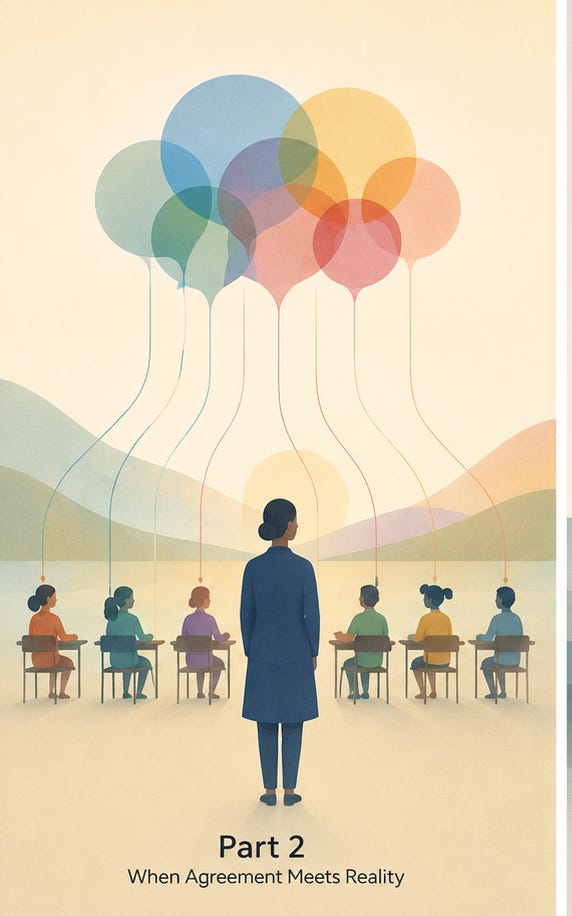
When Agreement Meets Reality
The previous post ended with an uncomfortable question. Suppose we somehow repaired our modern Tower of Babel. Suppose the psychologist, lawyer, teacher, economist and policymaker no longer used the same abstract words to mean subtly different things. Imagine that they sat around the table for as long as necessary and finally agreed on exactly what they meant by equality, inclusion, quality and responsibility. They would still approach the world from different disciplines and perspectives, but at least they would know where those differences lay and could integrate them into a coherent plan.
Surely that would solve a large part of the problem.
I am no longer so sure, because eventually even the best integrated plan has to leave the meeting room and meet the reality for which it was designed. And reality has the irritating habit of containing considerably more detail than any plan can possibly include.
Education offers an almost perfect place to watch that collision happen.
The Best Education Policy We Could Design
Imagine a government genuinely determined to improve education. Forget party politics for a moment and give our imaginary minister the benefit of every doubt. There is no ideological conspiracy, no incompetent administration trying to justify its existence and no minister primarily interested in tomorrow morning’s newspaper. Instead, the government does exactly what we constantly demand from governments: it consults the best available expertise.
Educational psychologists explain what we now know about motivation, cognitive development and the conditions under which children learn. Curriculum specialists examine what pupils need to know and where standards have weakened. Experts in inclusion contribute decades of experience with children who previously struggled or disappeared from mainstream education altogether. Economists look at a labour market being transformed by technology and artificial intelligence. Lawyers ensure that children’s rights do not depend entirely on the goodwill or prejudices of an individual institution. Teachers contribute practical experience, inspectors bring knowledge from hundreds of schools, and specialists in assessment try to find better ways of discovering which pupils are progressing and which are quietly being left behind.
There is nothing absurd about any of this. Quite the opposite: we would rightly object if governments ignored such knowledge.
This time, moreover, let us make the thought experiment especially generous. Our experts do not retreat into their professional silos. They listen carefully to one another, clarify their terminology and expose the conflicts between their priorities. They agree that raising academic standards may sometimes increase pressure, that individual adaptation consumes resources, that inclusion has practical limits, that every new objective takes time away from another and that equality cannot simply be invoked as a magic word whenever difficult choices arise. They do what good policymakers are supposed to do: they integrate.
After months of work, the resulting policy is impressive. It is ambitious without being completely unrealistic, inclusive without pretending that every child requires the same solution, attentive to well-being without reducing education to therapy and conscious of the need for both academic knowledge and preparation for a rapidly changing future. Some objectives have even been dropped because the group finally accepted that a school day contains only so many hours.
We have repaired Babel. The experts understand one another. The different perspectives have been integrated rather than merely piled together.
Now the policy has to work.
A year later it arrives in a classroom at half past eight on a Tuesday morning.
The teacher has twenty-six pupils. One has hardly slept because things are going badly at home. Another already understands the mathematics she is supposed to learn next week and is beginning to become bored. A third pupil is intelligent but has difficulty concentrating for more than a few minutes. One child barely understands the language of instruction. Another has discovered that disrupting the class produces considerably more attention than doing the exercises. Two pupils who were good friends on Monday have had a furious argument before school. The teaching assistant who normally helps one of the children has called in sick, three parents are waiting for replies to emails, and the digital platform on which part of today’s work depends has decided that Tuesday morning is an excellent moment to become unavailable.
None of this proves that the policy was wrong.
That is the interesting part.
The policy may be excellent. It simply cannot contain Tuesday morning.
The Eight Coxswains
There is an old management joke about two rowing teams entering a competition. One boat arrives with the traditional crew: eight rowers and a coxswain. The other organisation has also selected nine people, but through some mysterious management process it ends up with one rower and eight coxswains. When it inevitably loses the race, management commissions an investigation, restructures the team and concludes that the rower needs more training.
The joke works because we immediately recognise the organisation it mocks. Too many people are directing the work and too few are doing it.
Education sometimes looks uncomfortably similar. Around the teacher stand curriculum experts, psychologists, lawyers, inclusion specialists, inspectors, administrators, politicians, parents and increasingly digital systems, all carrying legitimate expectations about what should happen in the classroom. It is tempting to conclude that the answer is simply to reduce the number of coxswains.
But that would miss the more interesting point.
Our thought experiment has already solved that problem. We made the experts cooperate. We gave them one coxswain, so to speak. We integrated their advice into a sensible plan.
The boat can still encounter water that nobody saw from the shore.
The rowers feel resistance through the oars. They notice a change in balance, a gust of wind, fatigue on one side of the boat or a wave that was invisible from a distance. The coxswain remains essential, but even the best coxswain cannot experience every piece of information available to the people physically moving the boat through the water.
The teacher occupies a similar position. She does not merely execute the education policy; she continuously completes it. She decides whether today’s carefully planned lesson should continue when one pupil is about to lose control of himself, whether treating two children identically would actually be unfair, whether another ten minutes of explanation will help the struggling pupils or merely bore the rest of the class, and whether a rule that works perfectly well in most situations is making this particular situation worse.
The most important information required for those decisions was not forgotten by the experts. Much of it did not exist when they wrote the policy.
It appeared only when twenty-six particular children entered one particular classroom on one particular morning.
That distinction matters enormously. We often talk about frontline knowledge as if it were simply information that people at the top failed to collect. Sometimes it is. But a great deal of practical knowledge is created during implementation itself. A teacher discovers how a class reacts by teaching it. A doctor discovers how an individual patient responds after treatment begins. An engineer discovers interactions when separate components finally operate together. A customer-support specialist encounters combinations of software, hardware, configuration and workload that nobody could possibly have reproduced in every detail beforehand.
Reality does not merely contain more information than the plan.
Reality continues creating information after the plan has been written.
When Implementation Becomes Disobedience
This is where a sensible attempt to organise complexity can slowly turn into something much less sensible. When implementation differs from the plan, the people who designed the plan naturally want to know why. Sometimes the answer really is poor implementation. Teachers can be ineffective, doctors can make mistakes, engineers can ignore standards and local administrators can resist change simply because change is inconvenient. Giving people discretion is not the same as assuming that whatever they decide must be correct.
The problem begins when an organisation becomes unable to distinguish between bad implementation and intelligent adaptation.
If the centre assumes that its integrated model already contains the best possible answer, variation becomes suspicious. A teacher departing from the prescribed method is no longer responding to circumstances; she is failing to implement correctly. The obvious remedy is then more guidance, clearer procedures, additional training and better reporting. Each response makes perfect sense from the perspective of the centre, because the centre mainly sees the policy and the evidence describing whether that policy was followed.
The teacher sees something different. She sees the child.
And so a strange loop can begin. The more difficult reality proves to control from above, the more detailed the instructions become. The more detailed the instructions become, the less room remains for the people closest to reality to respond to what is actually happening. When outcomes remain disappointing, the organisation concludes that implementation is still insufficiently consistent and adds another layer of control.
This is one reason bureaucracy can become so inhuman without anybody ever deciding to make it inhuman. The individual child, patient, customer or citizen gradually disappears behind the categories needed to manage millions of children, patients, customers and citizens. The category is necessary; a ministry cannot govern twenty million individual stories. Yet the person implementing the policy eventually has to deal with precisely the individual story that the abstraction had to remove.
That tension cannot be eliminated by writing a better policy.
It can only be managed by recognising that intelligence has to exist at both ends.
The centre possesses knowledge that the individual teacher cannot have. It can compare thousands of schools, finance specialist support, protect children against arbitrary treatment, identify broad inequalities and gather research that no classroom teacher has time to conduct independently. But the teacher possesses another kind of knowledge: the immediate, constantly changing reality in which those broad objectives must somehow become education.
Neither can replace the other.
Perhaps this is where our modern Babel becomes more complicated than I first imagined. Part 1 was about specialists using the same words while attaching different meanings to them. Better communication can help with that. Experts can clarify their concepts, expose their assumptions and genuinely integrate their different perspectives.
But after all that work, they still possess a model.
A much better model, perhaps, but a model nonetheless.
The classroom remains a classroom.
The Part of the Plan That Cannot Be Planned
This suggests a rather different way of thinking about implementation. Instead of treating it as the last step in a chain—experts analyse, policymakers decide, administrators instruct and practitioners execute—we might see implementation as another part of the thinking process. The policy brings accumulated knowledge towards reality, but reality then has to send knowledge back.
That sounds obvious, and almost every modern organisation claims to believe in feedback. The difficult question is whether the feedback is actually capable of changing anything important. Too often the information travelling upwards is compressed into statistics, indicators and compliance reports, while the instructions travelling downward become increasingly detailed. Reality is allowed to improve the reporting system more easily than it is allowed to challenge the assumptions behind the policy itself.
Education merely makes the problem easy to see because everybody remembers sitting in a classroom and most of us immediately understand why twenty-six children cannot be reduced to twenty-six identical implementations of a policy.
But education is hardly unique.
Hospitals have protocols and individual patients. Companies have strategies and individual customers. Governments have regulations and individual citizens. Software companies have product specifications and customer environments nobody anticipated. In every case, the organisation needs abstraction in order to operate at scale, while the person at the other end eventually has to reconstruct the detail that abstraction removed.
So repairing Babel is necessary, but it is not sufficient.
We may learn to speak the same conceptual language, integrate the experts and even produce remarkably intelligent plans. Then Tuesday morning arrives, the doors open, twenty-six children enter the classroom and reality begins adding information that did not exist when the meeting ended.
Perhaps the real question is therefore no longer how we create the perfect plan.
It is how we build institutions in which reality is allowed to keep rewriting it.