

Thesis
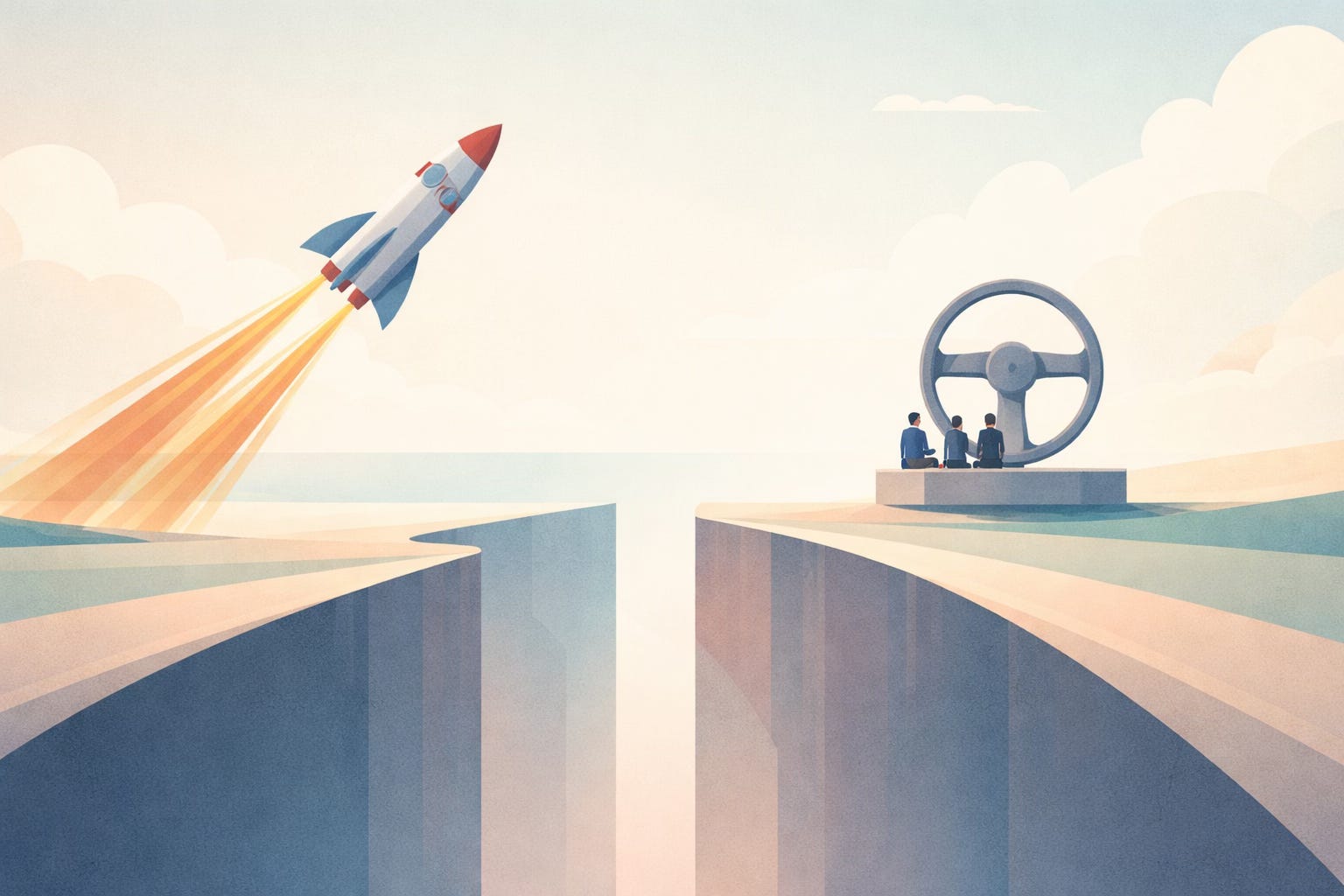
Technology is accelerating faster than our meaning-making and governing institutions can absorb, and the resulting mismatch is pushing Western societies toward distrust and regression; AI and robotics might still buy us a way through—if we convert productivity into legitimacy and shared stability.
There is a particular kind of silence you notice when technology changes too quickly.
It’s not the silence of people who have nothing to say. It’s the silence of people who don’t know which words still fit. The old vocabulary—work, skill, truth, authority, privacy, merit—starts to feel like it was designed for a world with slower feedback loops. A world in which cause and effect lived close enough together that you could still argue about them without losing the plot.
We are leaving that world.
Technology no longer arrives as a tool you adopt. It arrives as a climate you live in.
And our institutions—the ones shaped by centuries of humanistic inheritance: parliaments, courts, schools, newspapers, ministries—still behave as if their job is to interpret events after the fact. To debate. To deliberate. To weigh competing values, slowly, in public, with a faith that time is available.
Time is less available than we pretend.
The gap between machine speed and institutional speed is no longer an inconvenience. It is becoming the defining pressure in Western societies. And pressures like that do not remain abstract. They show up as distrust. As resentment. As a strange and growing temptation toward regression: a politics that promises to undo complexity rather than govern it.
You can call this “the humanities lagging behind.” That phrase has an edge to it, as if you were blaming literature seminars for failing to keep pace with GPUs. That would be unfair.
The humanities aren’t the problem. The problem is what happens when the institutions that were once custodians of meaning—education, law, public service, media—lose the ability to translate a changing world into a shared reality.
When that translation fails, people don’t simply become uninformed. They become unmoored.
And unmoored societies don’t ask better questions. They ask simpler ones.
Who did this to us?
Who benefits?
Who can we punish?
What can we bring back?
That is the emotional logic of regression.
It’s also, increasingly, the political logic of the moment.
The slow machinery of legitimacy
Democracy is not only a mechanism for choosing leaders. It is a mechanism for producing legitimacy. It turns disagreement into a process. It makes power answerable to something other than itself.
But legitimacy is fragile when reality changes faster than the process can track.
Technology compounds. Institutions bargain.
A technical breakthrough can be deployed at scale before a committee agrees on definitions. Before a regulator hires enough people to understand what they’re regulating. Before the public has had time to metabolize what has changed.
When the system can’t keep up, politics does what it always does under stress: it reaches for what is legible.
It reaches for symbolism.
It reaches for narratives that can be repeated.
It reaches for control—real or staged.
And staged control is not harmless. It erodes trust twice: first because it doesn’t work, and second because people can tell it’s performative.
This is why governance lag is so corrosive. It teaches citizens that the steering wheel is decorative.
The new face of cultural exhaustion
You can feel it in the strange texture of public life.
The constant argument about information: what counts as true, what counts as manipulation, who is “allowed” to speak, whether expertise is credibility or merely self-interest in a lab coat.
The constant argument about work: what counts as valuable, what counts as replaceable, whether the future is opportunity or dispossession.
The constant argument about identity: who belongs, who doesn’t, who is to blame for the unease we can’t name.
We blame technology for these tensions because technology is visible. We can point at it. We can be angry at it without confronting the harder fact: that our political and cultural systems have become bad at metabolizing rapid change.
The deeper failure is not technical. It is interpretive.
It is the failure to keep a shared map of reality.
And once the shared map collapses, politics becomes the art of distributing emotions rather than managing systems.
The paradox of our moment
Here is the paradox that makes this era so difficult to think about.
The same technologies that destabilize our institutions may also be our best chance to stabilize society.
We are entering decades of demographic strain and fiscal constraint. Healthcare systems groan under demand. Bureaucracies inflate to manage complexity, then become part of the complexity they manage. Schools try to teach in a world where attention is contested by an economy designed to harvest it. Work feels simultaneously over-documented and insecure.
In that world, productivity is not a sterile economic metric. It is the ability to keep promises: pensions, healthcare, public services, a sense that life can improve rather than merely be endured.
AI and robotics, if they deliver on even part of their promise, could create a profound productivity dividend. Not simply a new industry, but a new capacity to do more with less: fewer wasted hours, fewer administrative choke points, fewer human beings conscripted into the paper-shuffling layers that exist because systems are too complex to operate cleanly.
This is the hopeful version: technology buying us time.
Time to govern.
Time to retrain.
Time to adapt.
Time to rebuild trust.
But hope has conditions.
The condition: distribution becomes legitimacy
There is a darker version, and we do not have to imagine it. We have already practiced it, in smaller forms.
Technology increases productivity. The gains concentrate. Some people get convenience and leverage; others get precarity and surveillance. Work becomes a series of managed tasks. Public services become thinner. Citizens are told to “reskill” into an economy that is not, in fact, structured to receive them with dignity.
In that world, innovation becomes a synonym for displacement.
And then the political response is predictable: backlash, restriction, scapegoating, nostalgia as policy.
Not because people are irrational. Because people are trying to reassert agency in a world that feels like it’s being reorganized without their consent.
If we want AI and robotics to be an escape route rather than an accelerant, then we have to treat distribution as part of the design problem.
Not charity after the fact. Not rhetoric. Not “innovation hubs.”
Actual mechanisms that convert productivity into a life that feels more stable for most people: lower costs, better services, shorter workweeks, strong transitions into new roles, tax and welfare systems that don’t pretend labor is the only legitimate base while capital becomes increasingly automated.
This is not moral idealism. It is political realism.
People will support the future if they can live in it.
Why understanding is not enough
It is tempting to say: the fix is that politics needs to understand technology.
But the harder truth is that even if politics understood it, it might still fail—because our political systems are optimized for immediacy, conflict, and spectacle.
What we need is not merely comprehension. We need institutional capacity: regulators who can iterate, agencies that can audit, procurement rules that reward transparency, liability regimes that make incentives align with safety, public institutions that can hire technical competence without turning it into a revolving door.
The unglamorous stuff.
The work that does not trend.
The work that is the difference between a society that steers and a society that reacts.
A gentler way to say the same warning
Western societies are not doomed. But we are strained.
When a civilization cannot translate change into meaning, it becomes vulnerable to anyone offering simpler meanings. That is how you get regression: not as a conscious choice, but as a retreat into what feels comprehensible.
The question, then, is not whether technology will reshape society. It will.
The question is whether we will build institutions that can keep legitimacy intact while the reshaping occurs.
AI and robotics could give us the surplus—time, money, capacity—to do that.
Or they could become the final proof, in the public mind, that progress is something that happens elsewhere, to other people.
In the end, the danger is not that machines will replace humans.
It is that, in our exhaustion, we will replace reality with politics—and call it control.
And once that happens, no technology is fast enough to save us.