

Brussels, Apple, and the Gospel of Perfect Regulation
Europe has a talent for turning good intentions into administrative machinery.
The Digital Markets Act began with a perfectly reasonable idea. Big Tech had become too powerful. Apple, Google, Meta, Amazon and Microsoft were no longer just companies competing in markets. They had become private rule-makers. They controlled app stores, search, payments, browsers, operating systems, advertising systems, communication channels and increasingly the digital identity of citizens.
So yes, Europe was right to intervene.
But being right about the problem does not automatically make you right about the solution.
That is where Brussels so often loses the plot.
The European Union likes to see itself as the adult in the room. America innovates wildly. China controls brutally. Europe regulates wisely. That is the flattering story. In this story, Europe is the moral engineer of the digital age, defending citizens against the excesses of Silicon Valley.
There is truth in it. But only some.
Because the Apple-DMA fight now shows something less attractive. The EU is no longer merely protecting consumers. It is trying to build regulatory power. It wants to force the architecture of global technology to bend around European legal concepts. It wants to prove that access to the European market is so important that even the world’s largest technology companies must obey Brussels’ design philosophy.
This may sound impressive. It may even sound heroic.
Until European users start receiving advanced features later than everyone else.
Then the moral fog begins to lift.
Apple has already delayed or limited several features in Europe because of DMA-related disputes. The most visible recent case is Siri AI. Apple says it cannot safely launch the new AI assistant in the EU under the Commission’s interpretation of interoperability. Brussels replies that this is Apple’s choice. The law does not ban Siri AI. Apple simply refuses to comply.
Both sides are being clever. And both sides are being evasive.
Apple is not a charity with a brushed aluminium logo. It is a commercial empire. It has used privacy, security and user experience not only as product principles, but also as walls around a highly profitable castle. The App Store is not just a safe marketplace. It is a toll booth. Apple’s control over payments, browsers, app distribution and defaults is not merely benevolent curation. It is also market power.
So when Apple says, with its usual priestly calm, that everything is about protecting users, we should not bow our heads too quickly. Apple protects users. Apple also protects Apple.
But Brussels deserves no halo either.
The Commission behaves as if its legal architecture already contains the correct technical answer. The law has spoken. The platform must open. The gatekeeper must comply. The company must adapt. If a feature is delayed, that is the company’s fault.
This is the classic bureaucratic escape hatch. “We did not forbid the feature. We merely imposed the conditions that made the feature impractical.”
That may be legally convenient. It is politically dishonest.
Regulation works through incentives and constraints. If a law predictably causes companies to delay features, fragment services or avoid the European market, the regulator cannot simply shrug and say: “Not our decision.” It is your decision too. You designed the game.
The deeper problem is that Brussels is treating digital ecosystems as if they were simple markets. But they are not.
An iPhone is not just a shop. It is a security system, a privacy architecture, an identity layer, a payment device, a communications hub, a camera, a health sensor, a location device and soon an AI agent platform. When you command Apple to open one layer, you may affect all the others. That does not mean Apple should never be forced to open anything. But it does mean the answer cannot be found by legal theology alone.
This is especially true for AI assistants.
A serious AI assistant needs access to intimate digital life: messages, calendars, contacts, photos, documents, apps, location, personal history, even financial actions. If Apple’s Siri AI gets that access, regulators will ask why rival assistants cannot get similar access. Fair question. But if every assistant gets deep access, the risks multiply. Also fair.
This is not a problem you solve by shouting “contestability” from the Berlaymont.
It requires design. Sandboxes. Permission layers. Auditing. Liability. Gradual rollout. User choice that normal people can actually understand. Technical experiments. Independent security review. Different models for different architectures.
In other words, creativity.
And that is precisely what Europe’s regulatory machinery often lacks.
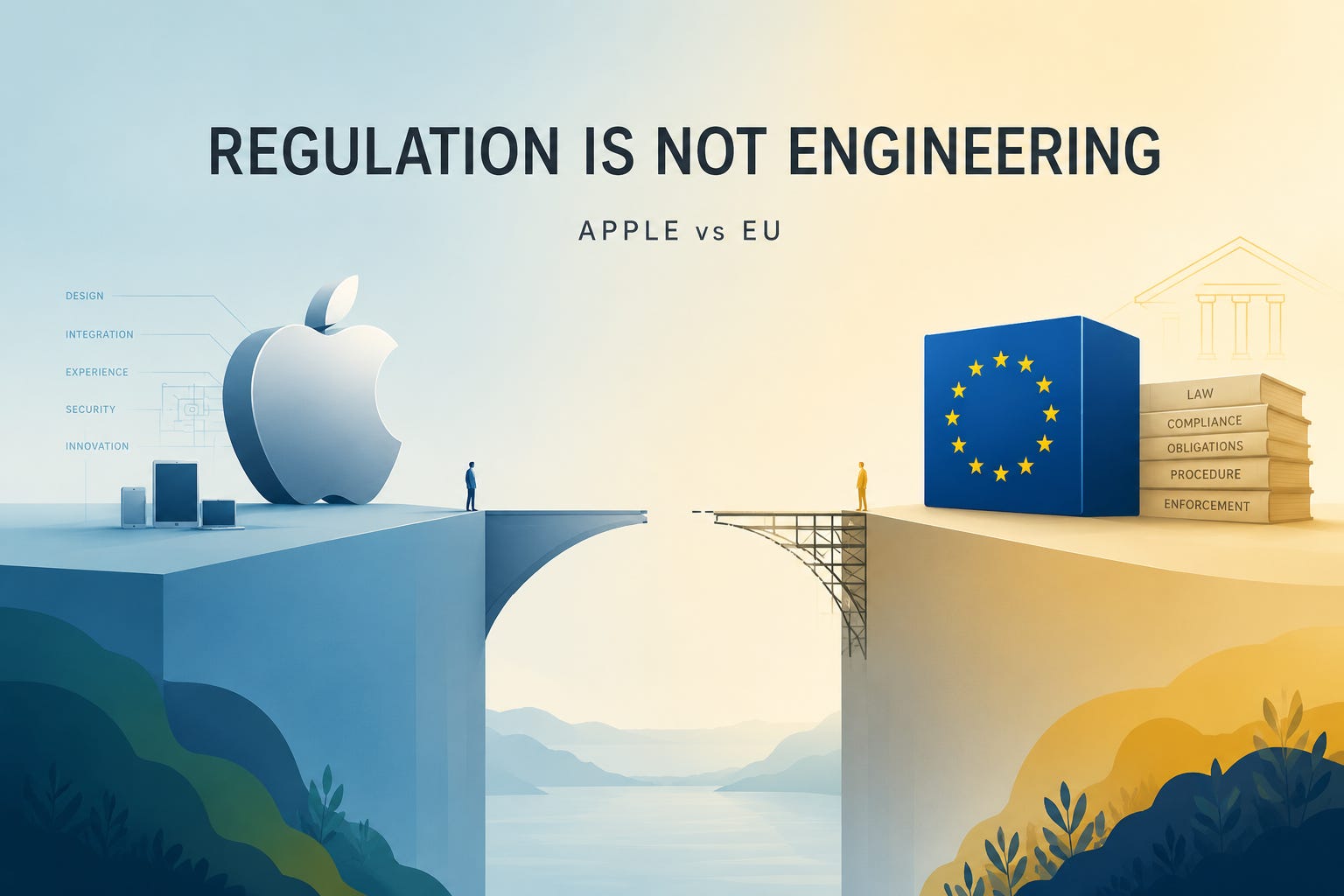
There is another layer to this conflict. Apple and the European Union are not simply two opponents in the same game. They are different species.
Apple is a technology company. Its native language is product, architecture, integration, user experience, security and ecosystem control. Of course, Apple is also a legal and lobbying machine. It probably has more lawyers working on European compliance than many European institutions have engineers who deeply understand operating-system architecture. Apple is no innocent garage startup. It is one of the most sophisticated corporate organisms on the planet.
But still, Apple’s centre of gravity is technology.
The European Union is different. Its centre of gravity is law. It thinks in competences, obligations, deadlines, procedures, definitions, enforcement powers and institutional mandates. That is not a weakness in itself. A democratic society needs law. Markets need rules. Powerful companies need external discipline. Without regulators, Apple would gladly define the public interest as whatever happens to fit inside the App Store business model.
But law is not engineering.
A lawyer can write that a platform must provide interoperability. An engineer then has to decide what this means in memory, permissions, sandboxing, APIs, authentication, logging, abuse prevention, latency, encryption and user consent. That translation is not trivial. It is the whole problem.
This is why the conflict is so sterile. Apple speaks as if technical complexity should give it the final word. Brussels speaks as if legal authority should give it the final word. Both are wrong.
Technology without law becomes private empire.
Law without technology becomes bureaucratic fantasy.
What Europe needs is not Apple’s surrender, and not Brussels’ sermon. It needs cooperation between two forms of expertise that do not naturally respect each other enough. Apple must accept that its beautiful ecosystem is also a market-control machine. The EU must accept that its beautiful legal categories do not automatically become safe software.
At the moment, both sides behave as if cooperation is a sign of weakness. Apple delays. Brussels scolds. Apple warns. Brussels fines. Apple invokes privacy. Brussels invokes contestability. Both have a point. Neither has a complete answer.
And meanwhile, the European user becomes the test dummy for institutional pride.
The EU talks endlessly about diversity. But in technology regulation, it often shows very little respect for diversity of solutions. Apple’s model is one model: closed, integrated, tightly controlled, privacy-heavy, sometimes arrogant, often elegant. Android is another model: more open, more flexible, more chaotic, often less secure, sometimes more innovative at the edges. Web apps are another route. Cloud AI another. Local AI another. Certified third-party agents another.
A mature regulator would say: show us how your model protects competition, users, privacy and security. We will test outcomes.
The EU too often says: our model is the model.
That is not diversity. That is harmonised superiority.
And this is where the famous Brussels Effect becomes more troubling. Europe has learned that it can regulate beyond its borders. Because the EU market is large, companies often adapt globally to European rules. This gives Brussels enormous soft power. Sometimes that power is useful. Sometimes it raises standards. Sometimes it forces lazy or abusive companies to behave.
But power without technological humility becomes dangerous.
Europe did not build the iPhone. It did not build Android. It did not build the leading AI models. It did not build the dominant cloud platforms. It did not build the app economy. It did not build the semiconductor stack on which all this depends. Yet it increasingly wants to redesign these systems by law.
That should make us nervous.
Not because companies should be left alone. They should not. Big Tech has too much power and too little accountability. Apple in particular has mastered the art of turning user trust into ecosystem control. It speaks the language of privacy while defending a very profitable walled garden. It deserves pressure.
But pressure is not the same as wisdom.
The EU’s weakness is that it confuses legal supremacy with technical competence. It believes that because a rule is democratically produced, it is therefore technically sound. That is a category error. Democratic legitimacy gives you the right to regulate. It does not magically give you the ability to design good software architecture.
There is also a nasty irony here. Europe wants digital sovereignty. It wants to be less dependent on American technology. Fair enough. But if European regulation makes Europe the slowest region for advanced digital features, then sovereignty becomes theatre. We do not become stronger by receiving innovation late. We do not become more independent by making ourselves a less attractive launch market. We do not help European developers by denying them early access to the tools their American and Asian competitors can already use.
The EU says it is defending consumers.
Perhaps.
But sometimes it looks as if it is defending the dignity of regulation itself.
Apple, meanwhile, is playing its own game. By delaying features in Europe, it puts pressure on the Commission. It makes users angry. It turns regulatory complexity into a political weapon. Apple knows very well that many people will blame Brussels first. That does not mean Brussels is innocent. But it does mean Apple is not merely the wounded innovator in this story.
Apple wants to preserve control. Brussels wants to impose control. The user is invited to applaud whichever control comes with better branding.
That is the tragedy.
The right question is not whether Apple or the EU should win. The right question is how Europeans get both innovation and protection. How do we keep Apple from abusing its ecosystem power without forcing all digital systems into a single bureaucratic mould? How do we make markets contestable without making devices less safe? How do we give users more choice without burying them under warnings, settings and fake consent screens? How do we regulate AI agents before they become dangerous without killing the useful ones before they arrive?
These are hard questions.
Hard questions require experimentation. Brussels prefers obligations.
Hard questions require humility. Apple prefers control.
Hard questions require dialogue. Both sides prefer theatre.
So we get the current mess. Apple says: we cannot safely launch. The EU says: yes you can, if you comply. Apple says: your rules damage users. The EU says: your business model damages users. Both are partly right. Both are partly hiding behind the part where they are right.
And European users wait.
This is not how a serious digital continent should behave.
Europe needs regulation, but it needs better regulation. Less sermon, more engineering. Less “dura lex, sed lex,” more “what outcome are we trying to achieve, and what technical paths can get us there?” Less confidence that the law already knows the answer. More willingness to test, adapt and admit that different systems may require different solutions.
Apple needs pressure, but it also needs competition that is real, not symbolic. Forcing open a platform is easy to write into a legal text. Making openness safe, useful and understandable is the hard part. If the EU cannot do that, it may win the legal battle and lose the technological war.
The uncomfortable truth is that both Apple and Brussels suffer from the same disease: institutional self-belief.
Apple believes its ecosystem is the best answer because Apple made it.
Brussels believes its rules are the best answer because Brussels passed them.
Apple has engineers who understand the machine, but also lawyers who know how to defend the toll booth.
Brussels has lawyers who understand the law, but too few people who understand what happens when a legal command enters a real operating system.
Reality is less impressed.
The future will not be built by companies that confuse control with care. Nor by regulators who confuse compliance with progress.
European citizens deserve better than a choice between Silicon Valley paternalism and Brussels paternalism.
They deserve technology that works, markets that are fair, privacy that is real, and regulation that is creative enough to understand the thing it is regulating.
That would be a Europe worth defending.
Not a Europe that protects us from innovation by arriving late to it.