

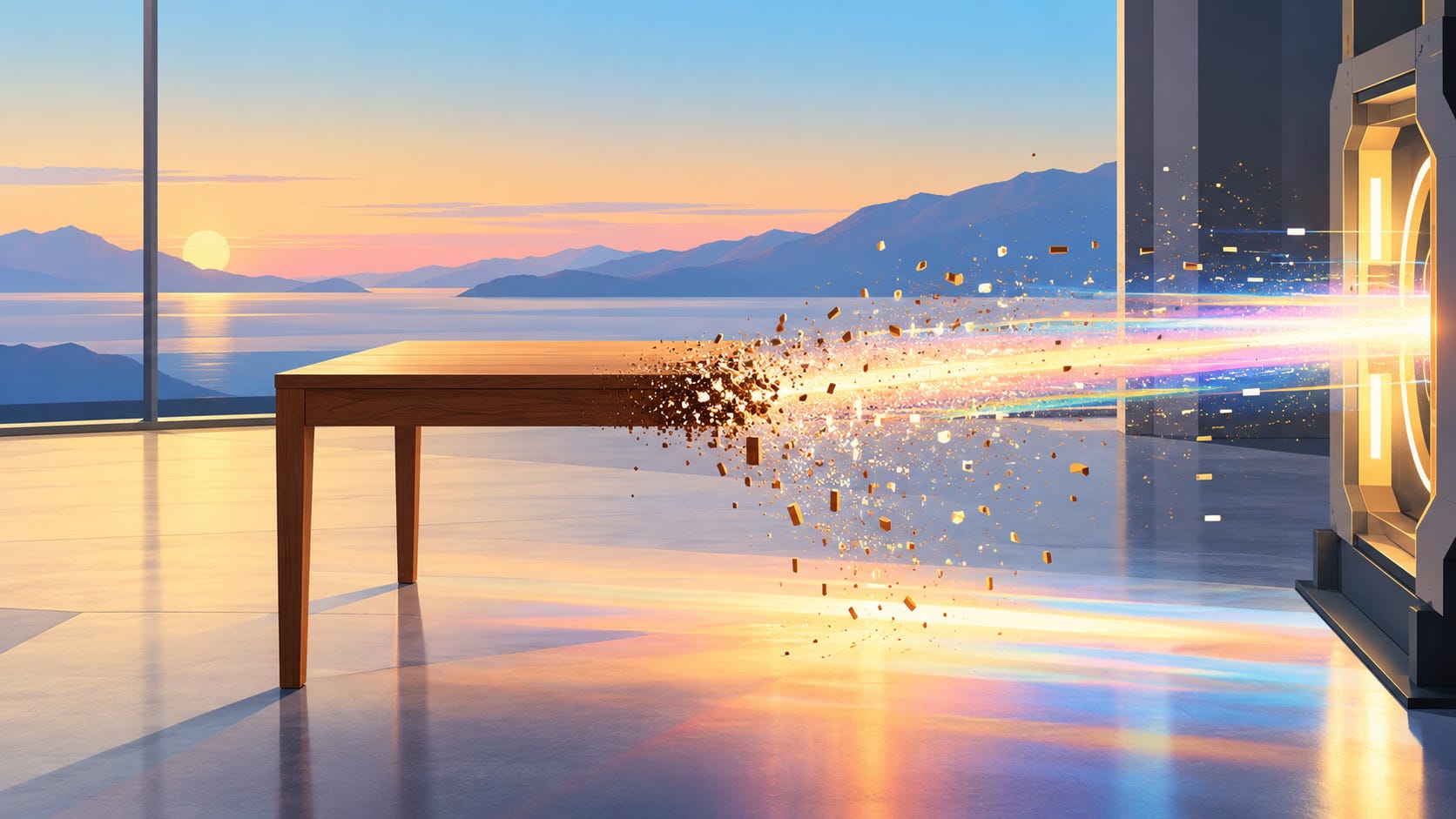
The first object ever erased was a table. This annoyed several people in the laboratory because it had been a perfectly good table.
Nothing dramatic was supposed to happen. The machine had been instructed to affect only an immeasurably small fraction of the wood, just enough to prove that the equations were not lying. For 1.7 microseconds, the room became considerably brighter than a room ought to be. Three windows disappeared. The table looked almost exactly the same. Someone weighed it. Someone else checked the machine. A third physicist sat down very slowly and said: “Oh.”
Einstein had warned them, of course.
A kilogram of matter corresponds to an absurd quantity of energy. Everyone in the room knew the equation. They had taught it to students. They had written it on whiteboards. Some had even printed it on coffee mugs.
Knowing an equation and watching a table obey it turned out to be different experiences.
The machine acquired a proper scientific name involving baryons, transitions and controlled fields. Within two days everybody called it the Eraser.
It erased nothing. That was the disturbing part. The universe kept its accounts perfectly balanced. Energy remained. Momentum remained. Charge remained. The table had simply discovered that being a table was not compulsory.
For billions of years, ordinary matter had behaved as though certain doors did not exist.
The Eraser found one.
The first machines were terrible power stations. They produced radiation, particles and several forms of energy that showed no interest whatsoever in being useful. Engineers spent thirty years learning how to persuade the result to remain inside the building. Eventually they succeeded.
After that, energy became embarrassing. A gram of matter could run a city for an astonishing length of time. A pebble became strategic infrastructure. Garbage became fuel. A broken kitchen tile contained more useful energy than generations of coal miners could have extracted from a mountain. Civilisation had spent centuries fighting over oil fields, gas pipelines, uranium deposits and access to sunlight. Then someone demonstrated that a spoon would do.
The advertisements arrived shortly afterwards.
POWER YOUR HOME WITH ALMOST ANYTHING.
Regulators objected to the word anything. The company replaced it with approved matter. This reassured nobody. The strangest change was not economic. It was domestic.
People began looking differently at objects. A chair was still a chair, but it now carried a second identity: several kilograms of tightly organised quantum persistence. A brick became unsettling. A dinner plate became vaguely threatening. An eighty-kilogram human being turned out to represent an amount of rest energy too large to contemplate politely over breakfast. Yet everyone continued behaving normally. People complained about electricity prices for another fourteen years, mostly from habit. Dogs slept on sofas containing enough theoretical energy to destroy cities. Children threw stones. Golfers cursed small white balls that stubbornly remained matter when they landed in water.
The universe had become absurd, but only because humanity had finally noticed.
The original table eventually went into a museum. A small piece of it survived behind glass.
One afternoon a girl stood looking at it with her grandmother. “So that thing could have become all that energy?”
“Not exactly.”
The girl waited.
Her grandmother had been a physicist, which meant simple questions tended to become dangerous. “The table wasn’t hiding energy inside itself like petrol in a tank. It was already a particular arrangement of fields and interactions. The machine simply found another arrangement it was allowed to become.”
The girl frowned. “So why didn’t it change before?”
“Because it was very good at being a table.”
That answer pleased her. She put her hand against the glass. The fragment remained perfectly still.
For almost all of human history, solidity had seemed obvious. Matter existed. Objects endured. Tables remained tables unless somebody burned them, broke them or left them outside in Belgian weather.
Then humanity discovered that permanence had been a misunderstanding. Nothing had guaranteed that the table must remain a table. Reality had merely made every other possibility fantastically unlikely. Until someone built a machine that whispered: You may.