

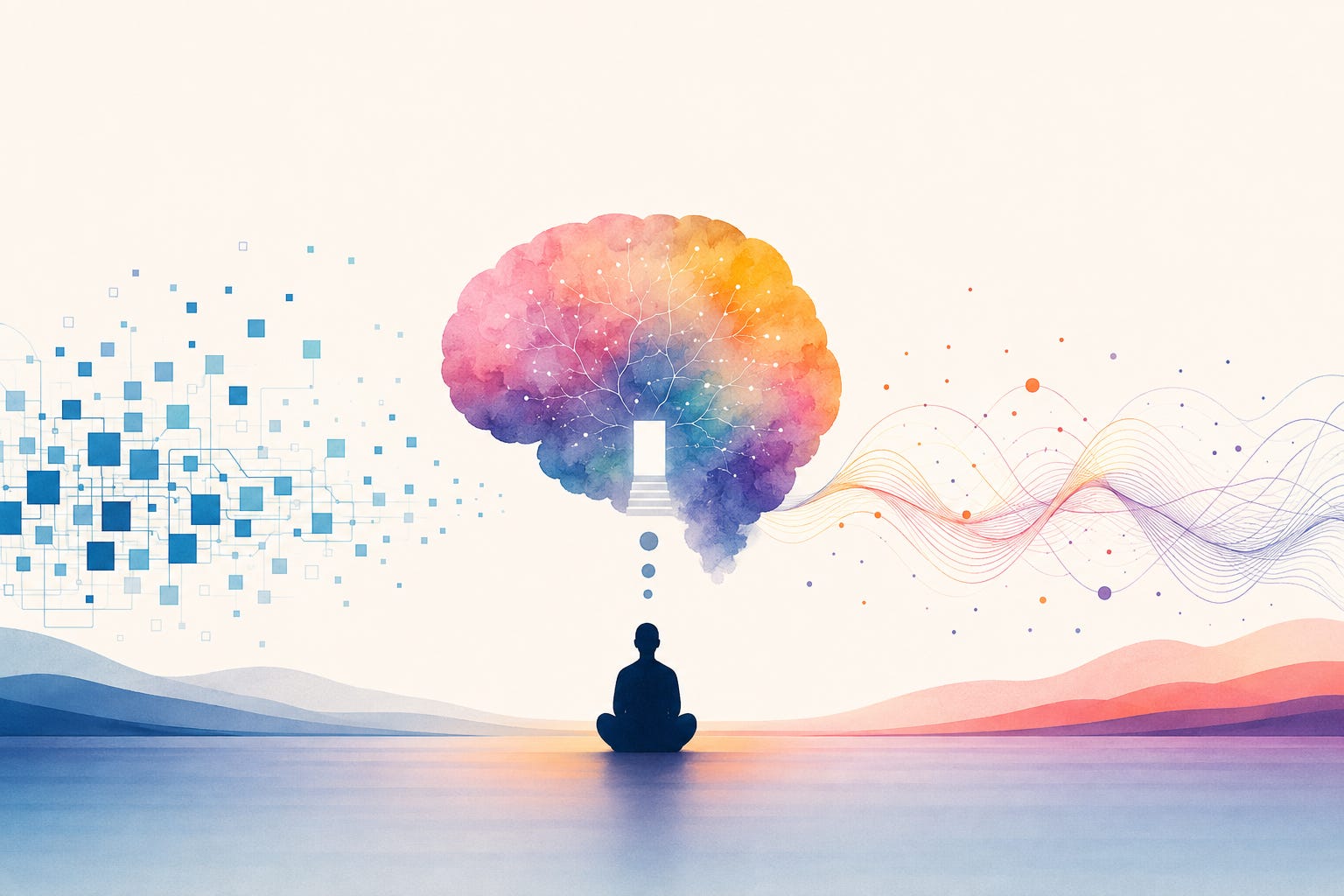
Quantum Spielerei: How Does a Thought Think?
“Don’t think about a pink elephant.”
Too late.
The elephant is already there.
Nobody showed it to you. Nobody described it. There isn’t one standing in your living room. Yet, within a fraction of a second, your brain quietly assembled a pink elephant from fragments of memory, colour, shape and imagination.
How?
Not what did you think.
But how did the thinking happen?
It is one of those questions we rarely ask because thinking feels effortless. We simply… think. Thoughts appear, disappear, collide, merge and sometimes refuse to leave us alone. They arrive so naturally that we hardly stop to wonder what is actually happening inside the three pounds of matter between our ears.
For more than two thousand years, philosophers have wrestled with that mystery. Today, neuroscientists can watch billions of neurons firing while you imagine that elephant. They know an astonishing amount about the brain’s chemistry, its electrical signals and its architecture.
Yet they still cannot point to the precise moment where electricity becomes an idea.
Perhaps that should not surprise us.
After all, we have spent centuries trying to understand thought with the only thinking machine we have ever known: ourselves.
Then we invented another.
The computer.
Most people instinctively assume that the brain works in roughly the same way. A neuron either fires or it doesn’t. One or zero. On or off. Build enough biological switches and, surely, intelligence emerges.
It is an elegant picture.
It is also far too simple.
A neuron may indeed produce an electrical pulse that resembles a digital signal. But everything leading up to that pulse is anything but digital. Thousands of incoming signals compete for attention. Some strengthen one another. Others cancel each other out. Timing matters. Chemistry matters. Hormones matter. Memories matter. Learning changes the strength of the connections themselves. Every experience subtly rewires the network that will generate tomorrow’s thoughts.
The neuron clicks.
The brain flows.
That distinction matters.
We often imagine thoughts as objects stored somewhere inside the brain, waiting to be retrieved like files from a hard drive.
But no scientist has ever found the neuron containing your grandmother’s smile, your first bicycle or Beethoven’s Ninth Symphony.
Thoughts appear to emerge from patterns spread across millions of neurons working together. They resemble a whirlpool more than a photograph. Every water molecule entering the whirlpool quickly leaves again, yet the whirlpool itself keeps its identity.
Perhaps thoughts are not objects.
Perhaps they are events.
Then look at the computer on your desk.
Its world is built on certainty.
Billions of transistors act as microscopic switches. Every one of them follows simple rules with relentless discipline. Zero. One. Zero. One. Every image, every spreadsheet, every website and every conversation with an AI eventually reduces to an unimaginably large sequence of tiny binary decisions.
There is no uncertainty hiding inside the machine.
Only extraordinary engineering.
Then physicists did something that sounded almost impossible.
They built a computer that no longer computes only with certainty.
The popular story says that a quantum computer tries every possible answer simultaneously.
It is a wonderful story.
It is also wrong.
A quantum computer does not magically know every solution. Instead, it manipulates possibilities. Quantum states behave like waves. Some reinforce each other. Others quietly disappear through interference. The art of quantum computing is not exploring every road, but arranging those invisible waves so that the roads leading nowhere gradually fade away while the useful paths become increasingly likely.
It does not calculate with answers.
It calculates with possibilities.
Now step back.
Nature has shown us at least three radically different ways of processing information.
The classical computer transforms definite symbols with astonishing speed.
The quantum computer shapes landscapes of possibilities before reality settles on one outcome.
The brain somehow turns chemistry, electricity, memory, emotion, expectation and experience into something neither silicon nor quantum mechanics has ever produced:
the feeling of having a thought.
That last step changes everything.
The brain is not mysterious because it might secretly be a quantum computer. There is no convincing scientific evidence for that.
It is mysterious because information somehow becomes experience.
Somewhere inside that endlessly changing network, electrical activity stops being just electricity.
It becomes the smell of fresh coffee.
The memory of your childhood home.
The excitement before a first kiss.
The sadness of losing someone you love.
The curiosity that made you read this sentence.
Physics can describe electrons.
Neuroscience can map neurons.
Computer science can explain algorithms.
Quantum mechanics can predict astonishing probabilities.
But none of them, at least today, can explain why one particular pattern of matter should feel like something from the inside.
Perhaps our greatest mistake has never been believing that computers might one day think.
Perhaps it is believing that thinking itself has only one meaning.
Birds fly.
Airplanes fly.
Seeds drift through the wind.
The word is the same.
The physics is entirely different.
Maybe thinking is no different.
Evolution found one way.
Engineers invented another.
Quantum physics revealed a third.
They all transform information.
They all obey the laws of nature.
But only one of them is reading these words and quietly wondering about itself.
And perhaps that is the most extraordinary computation the universe has produced so far.