

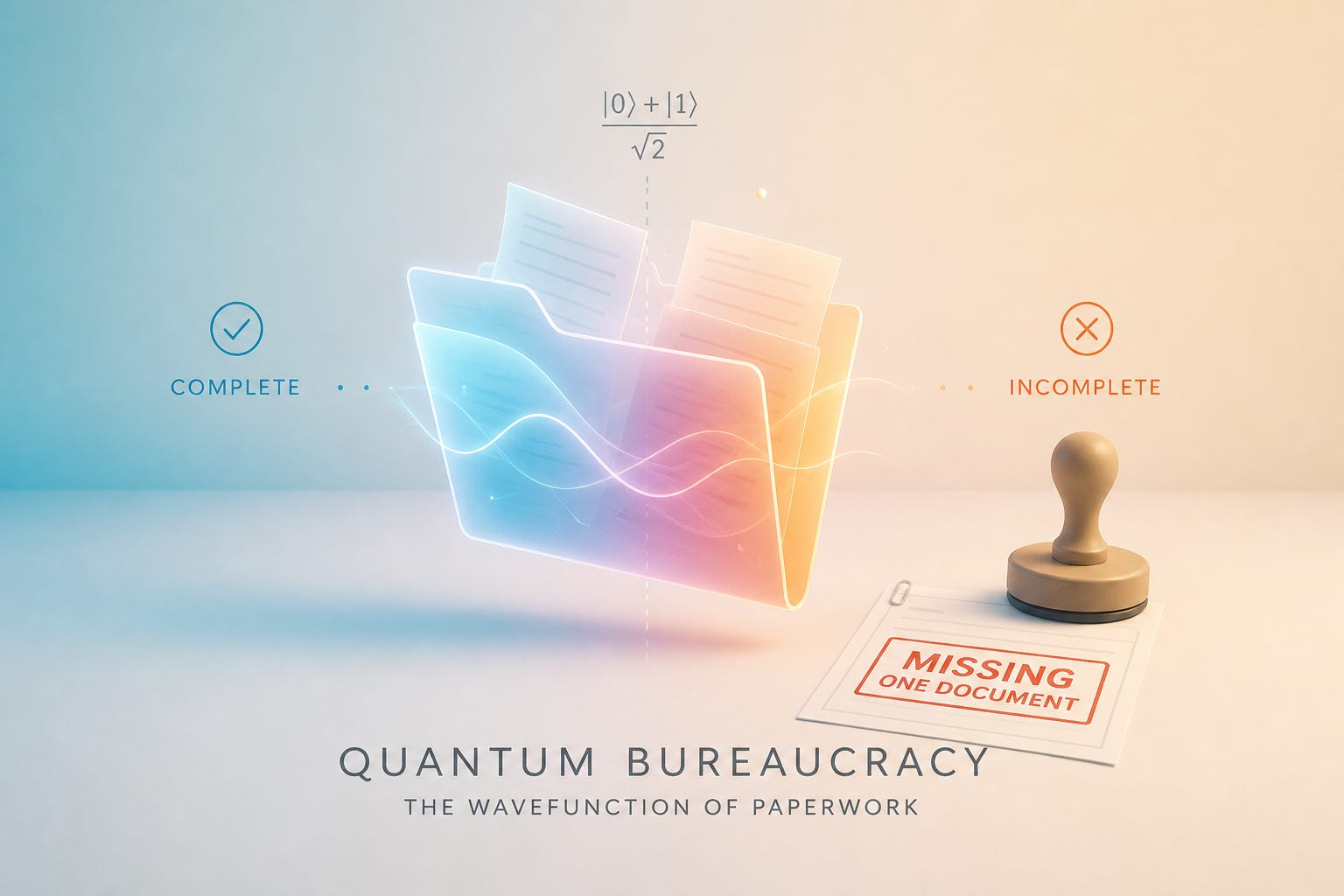
Quantum Bureaucracy — The Wavefunction of Paperwork
You enter the office with a folder so complete it could apply for citizenship on its own.
Copies? Yes.
Originals? Yes.
Proof of address, proof of identity, proof of proof, proof that the proof was recently printed on morally acceptable paper? Naturally.
You feel prepared.
This is your first mistake.
Because in bureaucracy, a file is never simply complete or incomplete. Like a quantum particle, it exists in a delicate superposition:
approved / rejected
valid / invalid
complete / “ah yes, but…”
All at the same time.
Until someone stamps it.
1. Before the Stamp: The Blessed Fog
Before observation, your dossier is pure potential.
The clerk has not yet looked at it.
The computer has not yet frozen.
The regulation has not yet remembered a subclause.
In this sacred pre-stamp phase, all futures remain possible.
In one universe, the clerk smiles and says, “Perfect, everything is in order.”
In another, you are asked for a document that was abolished in 2007 but still required by the software.
In a third, the office is closed for staff training on customer friendliness.
Quantum theory calls this superposition.
Citizens call it Tuesday.
2. Measurement: The Stamp of Doom
Then comes the decisive event.
The clerk takes your folder.
A silence falls.
Somewhere, an electron tunneling through a semiconductor pities you.
The stamp rises.
THUNK.
Reality collapses.
Your complete file instantly becomes:
“Missing one document.”
Not three documents. Not a dramatic failure. Just one.
Always one.
The final, sacred, invisible document without which civilization itself would clearly collapse.
3. The Uncertainty Principle of Administration
In ordinary physics, you cannot know both position and momentum with perfect precision.
In bureaucracy, you cannot know both:
what they need
and
why they need it
If you ask what document is missing, they say:
“It depends.”
If you ask on what it depends, they say:
“On the procedure.”
If you ask where the procedure is written, they say:
“Online.”
If you check online, the website says:
“Please contact your local office.”
At this point, Heisenberg quietly leaves the building.
He feels outclassed.
4. Entangled Departments
No bureaucracy is complete without at least two departments that appear separate but are mysteriously linked.
Department A says:
“We cannot proceed without confirmation from Department B.”
Department B says:
“We cannot issue confirmation until Department A proceeds.”
This is not incompetence.
This is entanglement.
Their answers are perfectly correlated across administrative spacetime, and no useful information can pass between them faster than the speed of lunch break.
Einstein called it spooky action at a distance.
The citizen calls it parking for a second hour.
5. Decoherence: The Collapse of Hope
At 9:04, you are a coherent human being.
Your folder is neat.
Your documents are clipped.
Your optimism still has a pulse.
Then the environment interacts with you:
the ticket machine,
the waiting room,
the printer that says “toner low” but means “abandon hope,”
the person before you who has brought a shoebox full of receipts,
the clerk who says, “My colleague told you that? Interesting.”
By 10:17, your internal wavefunction has decohered.
You are now classical.
Tired.
Observable.
Mildly hostile.
6. Many Worlds, None Convenient
Many-worlds theory says every possible outcome happens in some branch of reality.
There is therefore a universe where your form is accepted immediately.
There is another where the clerk says, “Don’t worry, we can look that up.”
There is even, statistically, a universe where the PDF upload works the first time.
But not this universe.
In this one, the required document exists only in the branch where you brought the other folder.
Final Stamp
Quantum physics teaches us that reality is not fixed until measured.
Quantum bureaucracy improves on this:
Reality is not fixed until stamped, scanned, rejected, re-uploaded, and reviewed by someone who is currently on holiday.
So the next time you walk into an office with a perfect file, remember:
Your forms are not complete.
They are merely not yet observed.