

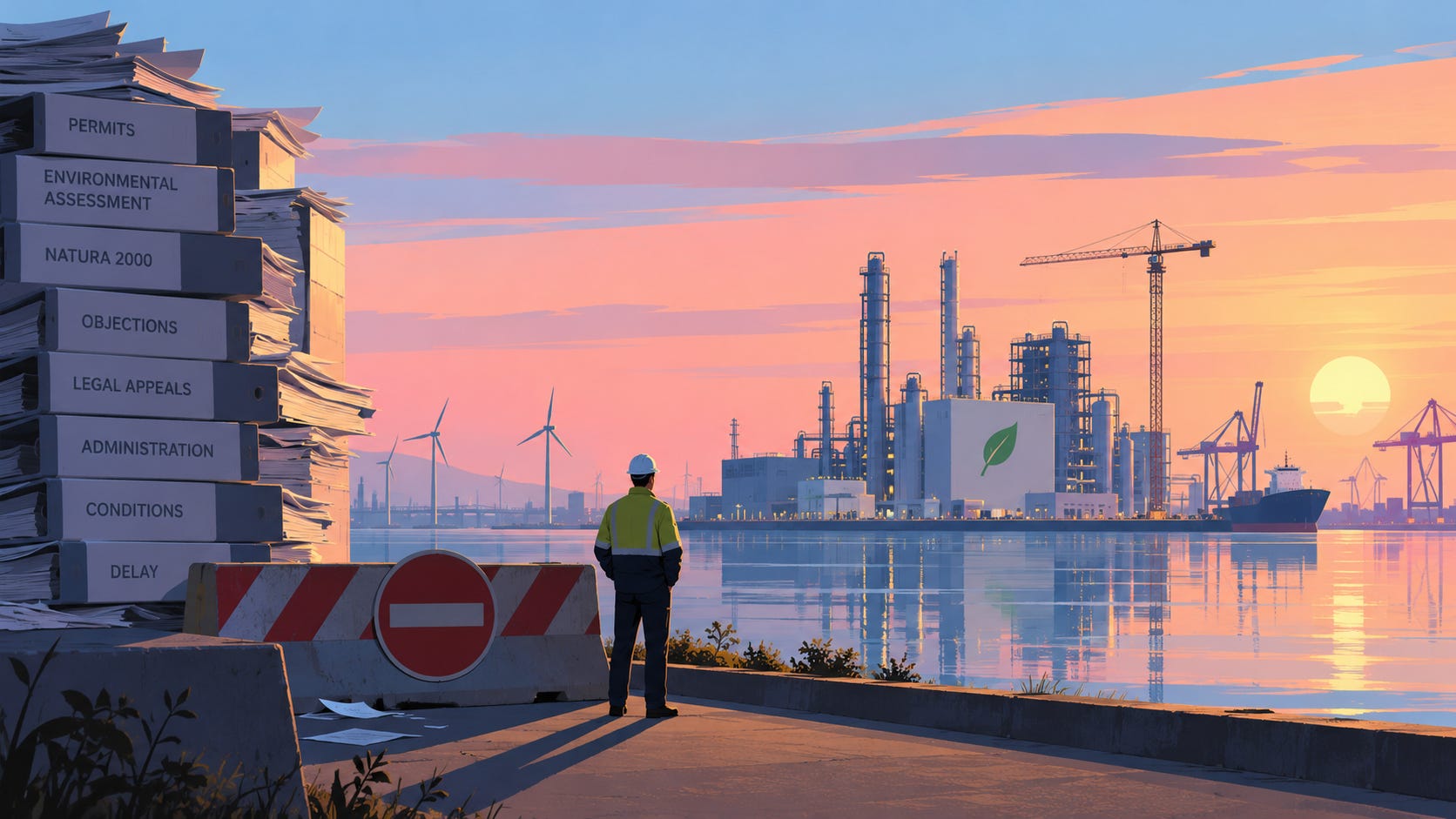
There is something endearingly European about deciding to save the planet and then designing the project as though the planet were more or less Europe with a few inconveniently distant provinces attached.
The objective itself is hardly absurd. Climate change is real, dependence on imported fossil fuels creates geopolitical vulnerability, and reducing pollution and greenhouse-gas emissions is a perfectly reasonable ambition for a rich technological society. Europe has also achieved a great deal: EU greenhouse-gas emissions in 2024 were roughly 35 percent below their 1990 level. The awkward detail is that the EU now produces only about 5.9 percent of global greenhouse-gas emissions while they continue to rise, with China accounting for almost 30 percent and India already above 8 percent.
That does not make European emissions irrelevant, nor does it erase the carbon embedded in everything we import. It does, however, change the nature of the problem. Europe can directly regulate only a relatively small part of a global atmosphere, while the countries responsible for most present and future emissions have governments, populations and economic priorities of their own. Brussels can influence them through trade, technology and the attraction of the European market, but it cannot issue a directive instructing India to become Denmark.
This should lead fairly naturally to one conclusion: if Europe wants an impact much larger than its own shrinking share of emissions, its greatest contribution may be to make cleaner technology so good, cheap and useful that the rest of the world adopts it voluntarily. A better battery, a cheaper industrial process, abundant low-carbon electricity or a heat pump that simply beats the alternative can travel around the world remarkably well without a European regulation attached.
Instead, much of European policy understandably has concentrated on the part governments could actually control: Europe itself. Targets have acquired dates, dates have acquired laws and laws have acquired sectoral obligations, carbon prices, standards, subsidies and reporting systems. The exercise has become increasingly sophisticated, but the atmosphere has remained stubbornly global. A ton of CO₂ emitted after a European factory moves somewhere else does not become environmentally harmless because it has acquired a different postal code.
Europe knows this, which is why it created the Carbon Border Adjustment Mechanism to limit carbon leakage and extend some European carbon pricing to imports. Again, that may be perfectly rational. But stand far enough back and the architecture becomes revealing: impose a demanding carbon regime at home, worry that production may leave because competitors do not face it, and then construct another mechanism around the border to prevent the consequences of the first mechanism leaking out with the factory. The battleship acquires another deck.
The danger is larger than carbon accounting. Europe may weaken precisely the industrial and technological capabilities through which it could exercise much more influence over the rest of the world. European industrial electricity and gas prices have been multiples of those faced by important American competitors, and the Commission now talks openly about affordable energy, industrial competitiveness and the danger of losing strategic production. It is a welcome change in vocabulary, although one might reasonably wonder why factories were ever treated as something that would patiently remain in place while policy experimented around them.
Factories are not spreadsheet cells. A chemical cluster, steelworks or automotive supply chain represents decades of engineering knowledge, specialised workers, suppliers, logistics and accumulated capital. Once it disappears, publishing a strategy announcing that Europe has rediscovered the importance of industrial sovereignty does not automatically bring it home.
Antwerp provides an almost painfully good example.
INEOS decided to build Project ONE there, a new ethane cracker costing more than €4 billion and described by the company as the largest investment in European chemicals in a generation. It is not a wind farm disguised as a chemical plant: it will process fossil-derived ethane, and environmental groups therefore have legitimate questions about its climate and nitrogen impact. But INEOS designed the plant to emit less than half the carbon per unit of output of even the best existing European crackers, with further provision for low-carbon hydrogen and later carbon capture. In other words, if Europe intends to continue consuming ethylene — and it certainly does — this was an attempt to produce it much more efficiently inside Europe rather than simply import it from somewhere less visible.
Then the European machinery met the European industrial ambition.
The original permit was granted, challenged and subsequently annulled in July 2023 because the assessment had not demonstrated in sufficient detail that nitrogen deposition would avoid significant effects on a protected Natura 2000 area across the Dutch border. INEOS produced an enormous revised assessment, eventually received a new permit and resumed construction, while further legal challenges continued. The first annulment effectively had halted work for months and also stopped further drawings under the project financing facility until a new permit was issued.
INEOS now claims that roughly nine months of delay caused about €1.5 billion in losses and has pursued compensation from the authorities. The government disputes the claim and says it sees no legal basis for compensating the company. So the €1.5 billion is not an established public liability; it is INEOS’s claim. But that hardly makes the episode less remarkable. Europe wants industry to invest billions in cleaner production, a company actually does so, the project becomes trapped in years of permitting and litigation, and the argument eventually moves from reducing emissions to determining who should pay for the delay.
There may have been sound legal reasons for every individual decision. That is exactly the point of this series. Every armour plate can usually explain why it exists.
The financing is almost as revealing. Project ONE did succeed in raising €3.5 billion, so it would be wrong to say Europe simply cannot finance large industrial projects. But look at what was required: 21 commercial banks, export-credit support from Britain, Spain and Italy, and a public guarantee facility covering part of the debt. Europe can still assemble enormous financing packages; it simply tends to assemble them rather than possessing one deep, frictionless pool of capital capable of swallowing such investments routinely. The broader diagnosis from the ECB and EIB is familiar by now: European savings are enormous, but capital markets remain shallow and fragmented compared with the United States, particularly when firms need large pools of risk and growth capital.
This becomes especially awkward when the green transition itself requires an almost absurd volume of capital. New generation grids, storage, batteries, hydrogen, industrial conversion, data centres and clean manufacturing all compete for money at the same time Europe is discovering that its financial architecture is much better at safely storing wealth than aggressively deploying it.
Electricity gives us the same paradox in miniature. I recently looked at one of my own dynamic-tariff bills and found that the electricity itself represented only about 18 percent of the total. I had become rather successful at buying electrons when they were cheap; unfortunately, electrons had become a minority shareholder in the electricity bill. Around them sat the network charges, taxes, levies and other regulated components required to operate and finance the system.
There is nothing scandalous about paying for a grid. Cables and transformers are not provided by nature alongside sunshine and wind. But Europe is simultaneously saying that cars, homes and industry must move onto electricity while discovering that the electrical grid cannot expand at anything like the speed of the policy ambition. In Flanders, companies can already encounter grid-congestion constraints and flexible connection arrangements precisely because available capacity is becoming scarce in some locations.
The rebellious IT guy has seen this migration plan before. Management announces the new platform, sets the deadline for retiring the old one, tells everyone how strategic the migration is and only later discovers that the network, servers and interfaces need substantial upgrades before everyone can actually log in.
Nobody literally forgot that electricity needs wires. The problem is that one part of the system was ordered to sprint while another remained trapped in regulated investment cycles, permitting procedures, local opposition and infrastructure lead times measured in years. Europe does not really have one captain steering this transition; it has European institutions, national governments, regional governments, regulators, municipalities, courts and network operators, all holding their hand on the helm.
Meanwhile the bill still arrives.
This is where efficiency, effectiveness and objectives collide. We want electricity to replace fossil fuels, but much of the cost loaded onto electricity has little to do with the wholesale price of the electron. We want industrial electrification but offer companies power at prices that can be substantially higher than elsewhere. We want new factories but can spend years deciding whether they may be built. We want the transition financed but have fragmented capital markets that struggle to mobilise European savings at continental scale. We want European clean technology, but we simultaneously demand the cheapest possible deployment, which naturally encourages buying equipment wherever somebody else can manufacture it more cheaply.
There is nothing inherently wrong with any one of these objectives. The problem begins when politics pretends they do not conflict.
The developing world adds the final dose of reality. Hundreds of millions of people still want more energy, more industrialisation, better housing, transport and higher incomes. Telling them that Europe has calculated an elegant transition path will not be enough. They will adopt lower-carbon technology at scale when it becomes economically attractive, reliable and compatible with development. If Europe wants genuine climate leadership, then producing those technologies may ultimately matter more than demonstrating its ability to regulate the last few percentage points of its own global emissions share.
That requires Europe to remain scientifically capable, industrially strong, financially ambitious and supplied with abundant affordable energy. Weakening those capabilities while pursuing climate targets and then constructing subsidy programmes to rebuild them is a remarkably elaborate route towards salvation.
The Commission’s recent emphasis on competitiveness, grids, cheaper energy and industrial resilience suggests that reality has finally acquired a seat at the table. That deserves recognition. Institutions should correct course when assumptions fail.
But course correction is not enough if we never reconsider the design principles that produced the problem. Europe should keep asking whether a policy reduces global rather than merely European emissions, whether other countries can realistically copy what we are doing, whether we are preserving the factories and engineering knowledge needed for the next generation of technology, whether our financial system can actually fund the transformation, and whether the price signals confronting citizens and industry point in the same direction as the policy speeches.
Otherwise Europe may achieve something uniquely impressive: cheap renewable electricity that remains expensive to use, cleaner factories that take years to obtain permission to become cleaner, billions in subsidies to replace industrial investment discouraged elsewhere in the system, and a beautifully documented climate transition that much of the planet decides it cannot afford.
Saving the planet was always going to require the planet.
Europe merely forgot, for a while, that the planet is not Europe.