

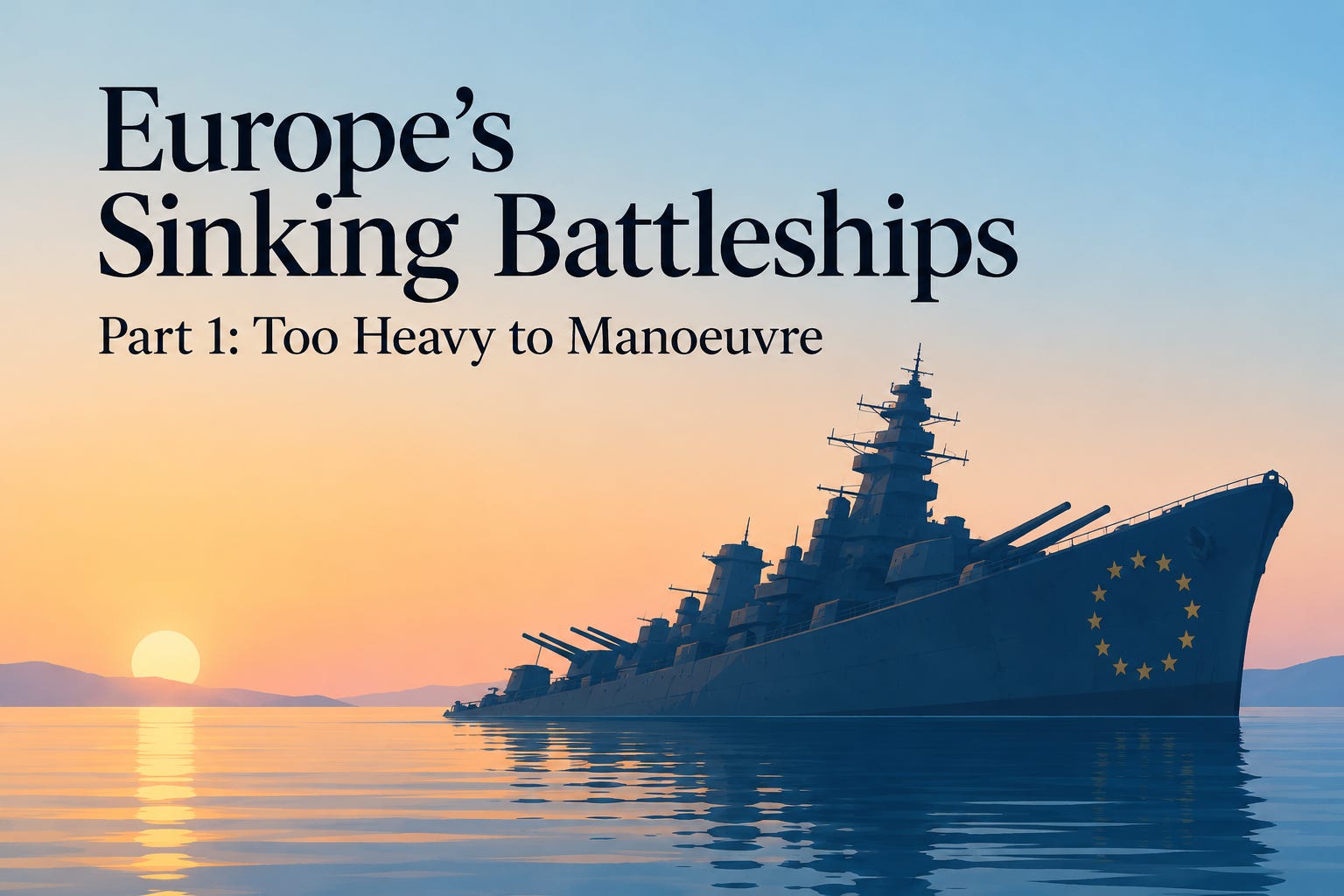
Europe has spent the last few decades building battleships. Impressive ones, in many cases: large structures of rules, protections and institutions, created for understandable reasons by a continent that wanted cleaner energy, safer products, stronger privacy, fairer competition and more social protection. None of that was foolish, and much of it was admirable. The problem is that Europe became extremely good at adding armour and gradually forgot that the ship was still supposed to move.
Every new concern produced another layer: a regulation, a reporting obligation, a target, an agency, a subsidy, an entitlement, a protected budget, a consultation, a certification system or a political compromise that gradually became untouchable. Each addition could usually be defended on its own, which is precisely why the system became so difficult to question. The trouble only becomes visible when you step back far enough to see the accumulated weight, because governments are much better at creating obligations than at ending them. A scandal produces a rule, a crisis an institution, a social problem an entitlement, a threatened sector a subsidy and a national interest another exception; years later the original circumstances may have changed completely, but the machinery and the constituencies built around it remain.
Bureaucracy has a ratchet, and once a policy has existed for long enough it stops being merely a policy. Civil servants administer it, lawyers interpret it, consultants advise on it, companies build compliance departments around it, NGOs monitor it and courts develop jurisprudence around it. What began as a solution gradually becomes an ecosystem, and ecosystems do not disappear simply because the original problem has changed. This becomes even more difficult when the measure has acquired the language of protection, because a debate about whether a mechanism still works well enough to justify its cost is easily transformed into a much more emotional question: why do you want to remove this protection for workers, consumers, privacy, minorities, the environment or financial stability?
That is why Europe so often simplifies without really subtracting. Forms are merged, exemptions created, reporting intervals reduced, one-stop shops established and competitiveness programmes launched, while the underlying structure largely survives. The armour is polished, rearranged and occasionally lightened, but rarely removed, even though the world outside the ship has become far less patient. Artificial intelligence can move from research curiosity to economic infrastructure in a few years, capital can cross continents in seconds, energy markets can be transformed by war and geopolitics, and Chinese or American companies can overturn industries before Europe has finished agreeing on how the next layer of rules should work. A battleship can be enormously powerful and still lose if it cannot turn quickly enough.
This is where the old idea of creative destruction becomes useful. Markets are brutal about obsolescence: companies disappear, products are discontinued, technologies are replaced and entire industries are transformed. More importantly, competition periodically forces companies back to first principles. Instead of merely asking how an existing product or process can be made cheaper or faster, somebody eventually asks whether it is still solving the right problem at all, and whether, starting from scratch with today’s knowledge and technology, anyone would design it this way.
Government institutions experience far less of that pressure. They certainly modernise, digitise and reorganise, but too often they innovate around the inherited architecture rather than questioning either the architecture or the objective behind it. A forty-year-old administrative process may acquire an app, an online portal and eventually an AI assistant without anyone asking why the process still exists, whether the policy still achieves what it was meant to achieve, or even whether the original goal should still have the same priority today.
That distinction matters, because efficiency is only the final question. Efficiency asks whether we can do something with fewer resources. Effectiveness asks whether what we are doing actually works. But before either comes the more uncomfortable question: are we still trying to achieve the right thing? A government can become wonderfully efficient at executing a policy whose purpose has been overtaken by technology, demographics, economics or geopolitics. It can automate the forms, reduce processing times and publish impressive performance indicators while becoming ever better at solving yesterday’s problem.
After decades of accumulation, institutions therefore need more than simplification. They occasionally need to return to basics, forget the inherited organisation, legislation and processes for a moment, and ask what problem society is actually trying to solve now. Does the original objective still deserve the same priority? Is the policy achieving it? Have circumstances created more important objectives that now compete with it? And if none of the existing machinery existed today, how would we design the solution from scratch?
Europe expects its economy to endure creative destruction, yet its governing structures are largely insulated from the same process of destruction and renewal. Companies fail, technologies disappear, jobs change and industries are transformed, while regulations, agencies, administrative structures, subsidies and political entitlements have a remarkable capacity to survive. That makes ageing institutions vulnerable not merely because they may become inefficient, but because they can become extraordinarily efficient at pursuing objectives that reality has already overtaken.
Blaming bureaucrats for this is too easy. Bureaucracies behave exactly as institutions tend to behave, because a department rarely gains influence by declaring that it has become unnecessary, while politicians gain far more by creating a visible benefit than by removing an old structure whose costs are dispersed across millions of people. Once a policy has produced beneficiaries, specialists and defenders, dismantling it becomes more difficult every year, until what looked like a temporary answer to a particular problem starts to resemble part of the natural order.
That is why Europe’s problem cannot really be solved by another grand strategy promising agility, competitiveness or simplification. The harder question is whether a mature democracy can create institutions that are capable not only of changing how they operate, but of reconsidering what they are trying to achieve in the first place. Can a regulation expire because the world has changed? Can a programme end because its purpose has been achieved? Can an agency shrink instead of inventing a new mission? Can an objective lose priority because another has become more urgent? Can a protection be replaced by something better without the change immediately being portrayed as an attack on the people it once protected?
In other words, can government practise creative destruction on itself without first being forced into it by crisis, collapse or revolt?
That is the question underneath this series. Europe still has extraordinary engines: wealth, science, universities, engineering, infrastructure, skilled people and a vast internal market. It is not short of intelligence, ambition or capacity, but it has accumulated an extraordinary amount of weight. In the parts that follow we will visit some of the battleships carrying it: regulation and technology, climate and energy, industry, agriculture, welfare promises, regional subsidies, defence, capital and the unfinished single market. They look very different from one another, yet behind them sits the same uncomfortable question: why is Europe so much better at creating structures and objectives than at deciding that some of them have served their purpose?
The danger is not that Europe has no power left. It is that everyone on the bridge can now see that the ship has to turn, while almost nobody is willing — or politically able — to reconsider the destination, let alone throw anything overboard.