

Democracy Is Stuck in the Age of the Strongman
There is a strange old reflex in politics. Whenever societies become anxious, they begin looking for the person at the front of the room.
The king, the president, the party leader, the revolutionary, the general, the prime minister, the founder, the saviour. Sometimes elected, sometimes not; sometimes dangerous, sometimes merely theatrical. But the shape is familiar. One person stands before the crowd and promises direction.
For most of history, this felt natural. A people needed a leader. A leader needed authority. Authority needed symbols. The symbols came with flags, ceremonies, speeches, uniforms, balconies and, in earlier centuries, a horse. Politics was imagined as command: someone at the top saw farther, knew better, decided faster, and carried the burden for everyone else.
The strange thing is not that politics developed this way. The strange thing is that it still so often works this way.
Outside politics, the world has been slowly learning another lesson. Modern complexity does not yield very well to heroic command. The best technology, science and business systems increasingly depend on collaboration, feedback and distributed intelligence. Open-source software is not built by one man on a balcony. Good research advances through disagreement and correction. Strong companies, at least when they are not busy worshipping their CEO, discover that complex problems are solved by teams that can share information sideways, test assumptions early and admit errors before they become expensive.
Even the corporate world, which still enjoys the myth of the visionary leader under flattering stage lights, has begun to understand that pyramids are not very intelligent. The person highest in the hierarchy is rarely the person closest to the problem. Knowledge does not sit obediently at the top. It is scattered through the organisation, in engineers, customers, nurses, teachers, technicians, clerks, users, local officials, and the inconvenient employee who quietly knows why the new system will fail.
In many areas, we are learning that intelligence is not a possession of the leader but a property of the network. It comes from feedback, correction, experimentation and the freedom to say that the plan is not working.
Politics remains attached to the older model.
This is visible even in democracies. Campaigns are built around faces. Parties turn leaders into brands. Debates become contests of posture. Cabinets try to control reality by controlling communication. A minister is expected to appear decisive even when the matter is too complex for decisiveness. The political system still wants someone to stand at the podium and say: trust me.
The problem is that fewer people do.
This is not because citizens have become stupid or lazy or uniquely cynical. It is because the old political model feels increasingly mismatched with the world it must govern. Climate systems, energy grids, financial markets, migration flows, digital platforms, artificial intelligence, biotechnology, cyberwar, housing markets and ageing populations are not impressed by speeches. They do not become manageable because a minister has announced a reform with three pillars and a tasteful logo.
Democracy was supposed to make power corrigible, and in the broad sweep of history it did something magnificent. It made it possible to remove rulers without civil war. It gave opposition a legal place, journalists the right to expose scandals, courts the authority to say no, and citizens the possibility of organising against those who govern them. That remains precious. One should never speak lightly about it.
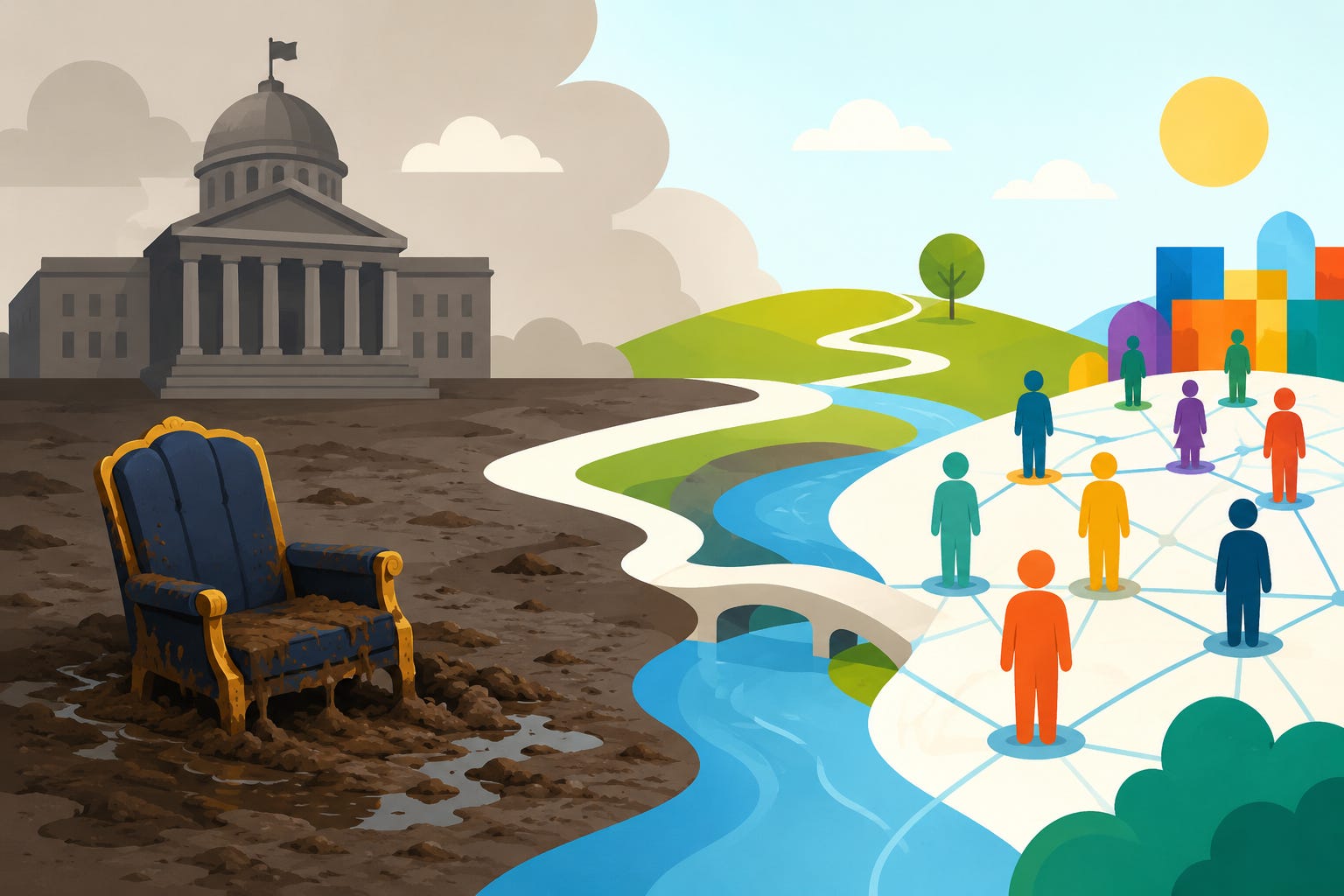
But democracy is not the end of the road. It is not a machine that, once installed, automatically produces wise decisions and competent institutions. It is an unfinished invention, and in many places it now seems stuck in mud.
The rituals are still there. Elections are held, debates organised, coalition agreements drafted, committees appointed, consultations opened and reform plans announced. Yet many citizens recognise the same experience. They vote, but the machinery barely moves. They complain, and the complaint is processed. They are consulted, and the consultation becomes a document. They are promised reform, and the reform becomes a logo.
The result is not dictatorship, nor even collapse. It is thinner than that, and more tedious. It is a democracy where the citizen remains sovereign in theory but becomes a spectator in practice. Once every few years, one chooses a political package. After that, the real machinery disappears into cabinets, administrations, party discipline, legal constraints, European negotiations, lobby circuits, budget techniques and implementation problems that were absent from the campaign because they are bad television.
A small example will do. A citizen encounters an absurd administrative rule. Perhaps the same document must be uploaded three times to three departments of the same state. Perhaps a temporary measure has survived for seventeen years. Perhaps a reform meant to simplify matters has produced a portal, a helpdesk, a second portal and a new category of errors. Nobody intended the absurdity. Everyone can explain why it exists. Nobody is quite responsible for removing it.
This is where political frustration comes from. Not from one scandal, one party or one minister, but from the repeated feeling that the system absorbs reality without changing shape.
The old feedback loops no longer work well enough. Elections are essential, but they are crude. One vote has to carry judgements about economic mood, party loyalty, public services, migration, taxes, climate, competence, identity, anger and hope. Media cycles are too frantic to reward patient learning. Governments are too complex for citizens to monitor in detail. Politicians are rewarded for visibility more than for maintenance. A new initiative can be announced; a bridge that quietly does not collapse cannot.
So politics produces theatre where it needs memory.
The same reforms return every decade with different vocabulary. Temporary measures become permanent furniture. Administrative failures survive because nobody with power experiences them personally. Responsibility dissolves across ministers, agencies, contractors and subcontractors until the question “who decided this?” becomes almost philosophical. Eventually someone says that lessons will be learned, and one suspects they are learned briefly before being released back into the wild.
This would be worrying in a stable world. It is far more worrying in a world where technology is accelerating faster than political institutions can understand it. Artificial intelligence, synthetic media, biotechnology, autonomous weapons, cyber capabilities and surveillance tools are not small administrative challenges. They may transform economies, labour markets, war, privacy, trust, knowledge and perhaps even the long-term survival of humanity. Some of these technologies may solve enormous problems. Others may create risks so large that our old political theatre looks almost childish beside them.
And who is supposed to steer this? The same systems that often struggle to build housing, simplify taxes, modernise schools or explain why a citizen must still submit a document the government already has.
That is the dangerous path: accelerating technology combined with slow, leader-centred, message-managed politics.
Politicians sense this loss of control, even if they rarely describe it that way. They speak of trust, responsibility, mandate and stability, but beneath the language sits an older instinct: keep the microphone, keep the hierarchy, keep the party line, keep the crash course under control. They are not uniquely wicked for doing so. Power always tries to remain power, and institutions defend themselves as naturally as organisms breathe. But the instinct becomes dangerous when the world requires more intelligence than any hierarchy can provide.
The future cannot be governed by press conference.
What is needed is not less democracy, and certainly not the replacement of politics by experts, judges, markets or algorithms. Politics exists because people genuinely disagree about what matters. A society is not a logistics network. People want efficiency, but also dignity, fairness, recognition, security, identity and a voice in decisions that shape their lives. A perfectly optimised policy can still feel illegitimate if it arrives from nowhere and treats citizens as objects to be managed.
The answer is deeper democracy.
That phrase risks sounding like something from a conference badge, but it points to a practical need. Democracy should not mean occasional voting followed by years of spectatorship. It should make public decisions more visible, more traceable and more capable of correction. It should remember past failures instead of ritually rediscovering them. It should connect promises to budgets, laws to implementation, and decisions to consequences. It should allow knowledge to flow not only upward through party and administrative hierarchies, but also sideways from citizens, professionals, local officials, independent experts and the people who actually experience the system at street level.
This is where artificial intelligence becomes interesting, though not as a saviour. The last thing democracy needs is a digital strongman with better grammar. AI should not decide what kind of society we must become. It cannot be voted out, cannot carry moral responsibility, and can reproduce old injustices with new confidence. It can also be wrong in a tone so polished that error arrives wearing a suit.
But AI could help democracy see.
It could give institutions a memory they currently lack. Before a major reform is announced, it could show what happened when similar reforms were tried before, what they cost, what failed, who warned about the failure and which recommendations were ignored. It could help test draft laws for contradictions and predictable administrative chaos before citizens are forced to discover them in practice. It could make public procurement less hospitable to strange patterns and convenient coincidences. It could help citizens understand policy trade-offs in plain language instead of leaving them trapped between slogans and specialist reports. It could track political promises after the posters have been removed.
None of this would end disagreement. Nor should it. But it could make disagreement better informed and less dependent on collective amnesia.
The danger, of course, is that AI may deepen the wrong things. Autocrats will use it to monitor citizens. Parties will use it to manipulate emotions. Bureaucracies may use it to hide behind automated decisions. Vendors will sell magical dashboards that create new dependencies. Citizens may be scored, classified or refused by systems nobody understands. If AI is simply placed on top of existing power, it will probably strengthen existing power.
The democratic question is therefore not whether government will use AI. It will. The question is who AI will make more visible.
If it mainly watches welfare claimants, migrants, small taxpayers and ordinary citizens who make mistakes in forms, it will become another instrument of control. If it also watches procurement, lobbying, subsidies, regulatory capture, forgotten promises and administrative failure, it may become part of a democratic immune system.
That distinction matters. AI is useful for democracy only if it strengthens accountability. It must help citizens see what power is doing, not merely help power see citizens more clearly.
The old strongman model says: trust the leader. A deeper democratic model says: trust only what remains visible, contestable and capable of correction. Leaders will still matter. Someone must speak, choose, decide and be held accountable. But the leader should no longer be treated as the brain of democracy. At best, the leader is its servant.
The real intelligence must come from the whole system: citizens, institutions, experts, local knowledge, open debate, independent scrutiny, public data and feedback loops strong enough to embarrass power before power becomes disaster.
Politics will never be solved. It is the price we pay for living together without constantly reaching for clubs. But democracy can grow deeper than the ritual of choosing leaders and hoping they know what they are doing.
It can learn to ask harder questions in public. What was promised, and what happened? What failed last time? Who benefits, who pays, and what are we pretending not to know? Which warning was ignored? Where did the money go? Why does the temporary measure still exist after seventeen years? And why, when the rest of the world is learning to solve complex problems through collaboration, does politics so often still behave as if history is waiting for one strong person with a microphone?
That may be the real question. Not whether democracy is dying, but whether it can grow up before technology outruns it.